
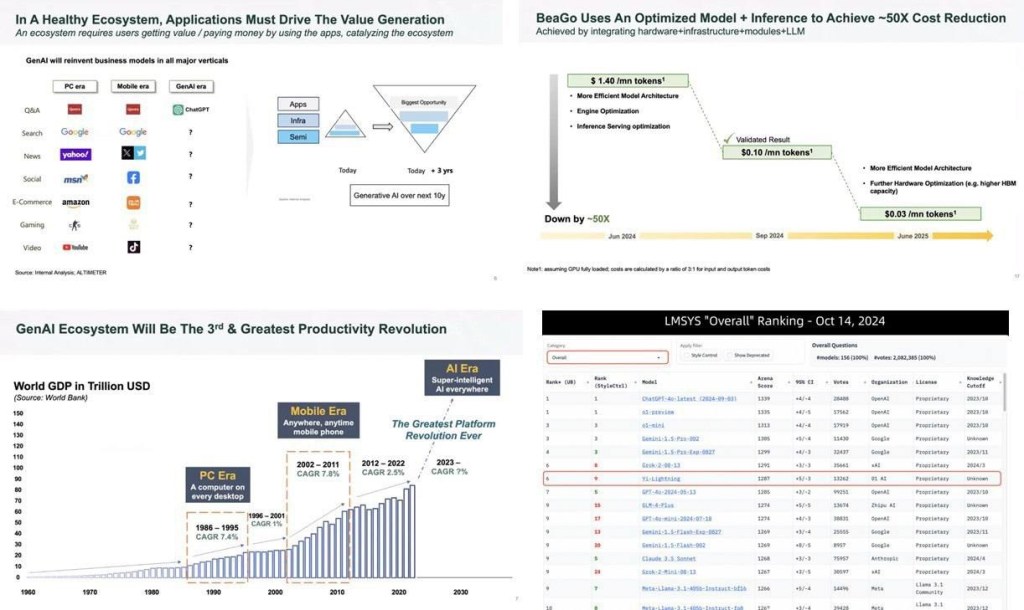
Kai-Fu Lee, a prominent figure in the AI field, has declared a competitive stance against Nvidia and the broader U.S. AI ecosystem, asserting that significant changes are necessary for real progress. In a recent talk at Collective[i] Forecast, he characterized the current U.S. AI landscape as “incredibly sick” and in need of radical restructuring. According to Lee, the ecosystem is overly reliant on Nvidia and small AI chip manufacturers, who collectively earn $75 billion annually, while infrastructure and application vendors generate significantly less. He warns that this inverted economic model is unsustainable and suggests that AI companies must develop their own vertically integrated technology stacks, similar to Apple’s approach with the iPhone, to lower the costs associated with generative AI.
Lee emphasizes the need to focus on reducing the cost of inference, which is crucial for making AI applications more accessible to businesses. He highlights that the current pricing model for services like GPT-4—$4.40 per million tokens—is prohibitively expensive compared to traditional search queries. This high cost hampers the widespread adoption of AI applications in business, necessitating a shift in how AI models are developed and priced. By lowering inference costs, companies can enhance the practicality and demand for AI solutions.
Another critical direction Lee advocates is the transition from universal models to “expert models,” which are tailored to specific industries using targeted data. He argues that businesses do not benefit from generic models trained on vast amounts of unlabeled data, as these often lack the precision needed for specific applications. Instead, creating specialized neural networks that cater to particular sectors can deliver comparable intelligence with reduced computational demands. This expert model approach aligns with Lee’s vision of a more efficient and cost-effective AI ecosystem.
Lee’s startup, 01. ai, is already implementing these concepts successfully. Its Yi-Lightning model has achieved impressive performance, ranking sixth globally while being extremely cost-effective at just $0.14 per million tokens. This model was trained with far fewer resources than competitors, illustrating that high costs and extensive data are not always necessary for effective AI training. Additionally, Lee points out that China’s engineering expertise and lower costs can enhance data collection and processing, positioning the country to not just catch up to the U.S. in AI but potentially surpass it in the near future. He envisions a future where AI becomes integral to business operations, fundamentally changing how industries function and reducing the reliance on traditional devices like smartphones.
 CHUCKYSCARNAGE