
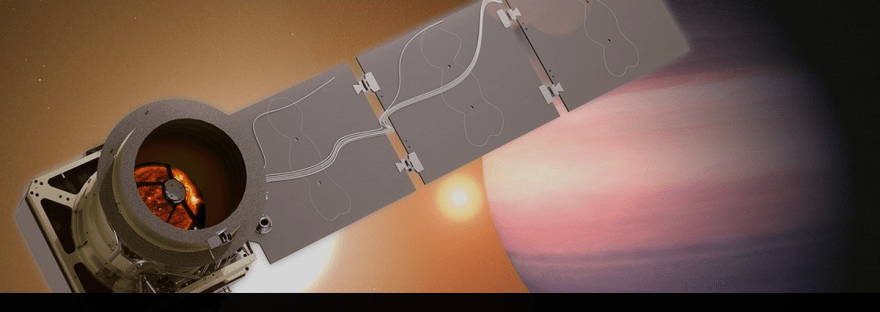
Pandora, NASA’s newest exoplanet mission and the first satellite to launch through the agency’s Astrophysics Pioneers program, is now making unique observations of worlds beyond our solar system and the stars they orbit. The mission will determine the atmospheric make-up of at least 20 exoplanets, including the presence of hazes, clouds, and water. “Pandora’s data […].
NASA’s Pandora Mission Begins Study of Exoplanets, Host Stars. “Pandora’s data will help close a major gap in our knowledge about planets and their host stars because, right now, we can’t be entirely sure how the star’s light affects measurements of what makes up exoplanet atmospheres,” said Elisa Quintana, Pandora’s principal investigator at NASA’s Goddard Space Flight Center in Greenbelt, Maryland. “We designed the Pandora spacecraft and its in-depth observing program to better understand this vexing issue.” Artist’s concept of NASA’s Pandora mission, which will help scientists untangle the signals from exoplanets' atmospheres and their stars.
NASA's Goddard Space Flight Center/Conceptual Image Lab Download high-resolution video and images from NASA's Scientific Visualization Studio The results of the mission will lay a firm foundation for interpreting measurements by NASA’s James Webb Space Telescope, as well as future observatories focused on finding habitable worlds. In fact, Pandora’s near-infrared detector is a spare originally developed for Webb. "The spacecraft is healthy and all of the instruments are performing as well as we could have hoped,” said Jordan Karburn, Pandora’s deputy project manager at Lawrence Livermore National Laboratory in California.
“Our team’s hard work throughout the commissioning process has paid off, and we can now confidently start science." This artist’s concept summarizes NASA’s Pandora mission and its science goals. Pandora will repeatedly observe multiple planets and their host stars in both visible and near-infrared light.
Discover more from ChuckysCarnage
Subscribe to get the latest posts sent to your email.

