
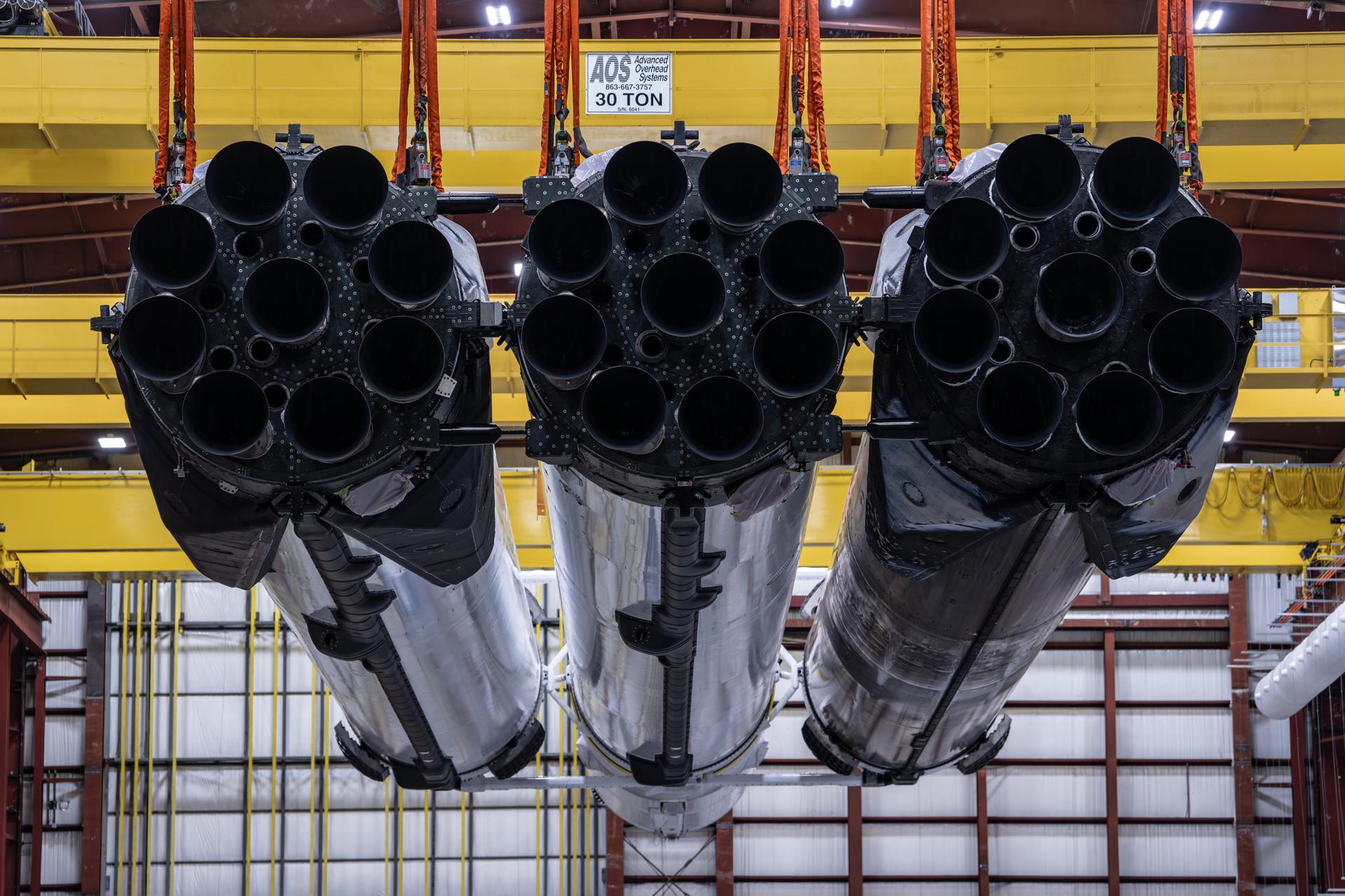
NASA’s Nancy Grace Roman Space Telescope is “go” for launch following completion of the agency and SpaceX’s Launch Readiness Review Friday at NASA’s Kennedy Space Center in Florida. NASA’s Roman Space Telescope ‘Go’ for Launch. The Launch Readiness Review is the final review before proceeding into launch countdown.
It confirms if Falcon Heavy, the Roman observatory, weather, and supporting teams are ready for liftoff. Space Force’s Space Launch Delta 45 Weather Squadron are predicting a 60% chance of favorable weather conditions for launch, which is targeted for 7:26 a.m. This will be the sixth NASA primary mission with SpaceX to launch on a Falcon rocket from Kennedy, after IXPE (Imaging X-ray Polarimetry Explorer), Psyche, NOAA’s GOES-U (Geostationary Operational Environmental Satellite U), Europa Clipper, and IMAP (Interstellar Mapping and Acceleration Probe).
Roman’s deep, sweeping surveys will help investigate dark energy and dark matter, discover and characterize planets beyond our solar system, map billions of galaxies, study black holes, and share enormous amounts of data with both scientists and the public. To learn more about the mission: www.nasa.gov/roman Elyna Niles-Carnes August 28, 2026 2:06PM Categories.
NASA’s Roman Space Telescope will combine Hubble-like detail with a field of view 100 times larger, giving astronomers a sweeping new way to explore the cosmos. Its observations could uncover hidden planets, map billions of cosmic objects, and help scientists unravel the mysteries of dark matter and dark energy.
NASA’s Roman telescope will see 100 times more sky than Hubble. Com NASA’s Nancy Grace Roman Space Telescope is now just two days from launch, marking the arrival of the agency’s next flagship astrophysics mission after the James Webb Space Telescope.
University of Arizona faculty and students will be watching from Cape Canaveral as Roman begins its journey toward science operations, which should start in January 2027. Unlike Webb, which was built to study relatively small regions of the universe in extraordinary depth, Roman aims to survey vast areas of the sky quickly.
Both observatories can detect infrared light, giving astronomers the ability to compare and combine their observations. Used together, the two missions could reveal far more about the universe than either telescope could on its own.
A Hubble-Sized Mirror With a Much Wider View Roman has a 7.9-foot primary mirror, the same diameter as the Hubble Space Telescope’s, along with two major scientific instruments.
Discover more from ChuckysCarnage
Subscribe to get the latest posts sent to your email.

