Astronomers have found two clouds of hydrogen near the Whirlpool galaxy that appear to contain almost no stars. The clouds, discovered with China's FAST radio telescope, each contain roughly 3 million times the mass of the sun in hydrogen but have no detectable optical counterpart. Their properties are outlined in a new paper published in the Astronomy & Astrophysics journal on Aug.
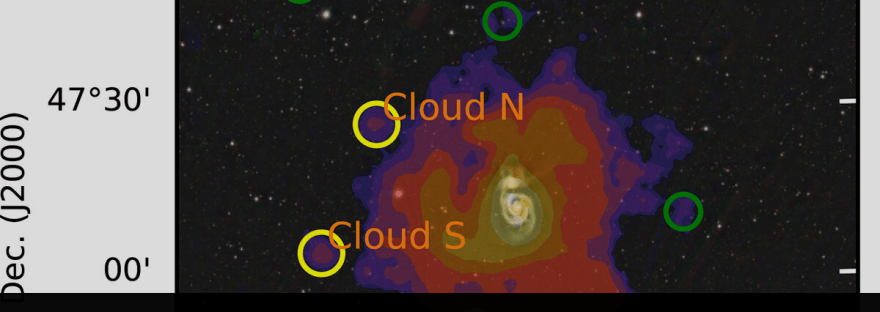
FAST finds two mysterious hydrogen clouds with no visible stars. September 5, 2026 report FAST finds two mysterious hydrogen clouds with no visible stars by Shreejaya Karantha, Phys.org Shreejaya Karantha Author Meet our staff & contributors Learn about our editorial standards edited by Robert Egan Robert Egan Senior Editor Meet our editorial team Behind our editorial process Editors' notes This article has been reviewed according to Science X's editorial process and policies. Editors have highlighted the following attributes while ensuring the content's credibility: fact-checked peer-reviewed publication trusted source proofread The GIST Add as preferred source H I distribution in the vicinity of M51 overlaid on a Pan-STARRS1 DR1 optical image.
The yellow circles indicate the locations of the two RELHIC candidates: Cloud N and Cloud S. The color shows the H I column density (moment 0) map. The green circles indicate other H I components identified by SoFiA.
The blue dot in the bottom-left corner represents the 3.24′ FAST beam (FWHM) at 1.42 GHz. A physical scale bar of 50 kpc (assuming a distance of 8 Mpc) is provided in the bottom-right corner. Starless ghosts According to the standard Lambda Cold Dark Matter (LCDM) model of the universe, structure forms hierarchically: Small dark-matter halos form first, then merge to build larger halos and galaxies.
But not every dark-matter halo should become a galaxy because several processes can suppress star formation at sufficiently low masses. If a halo's gravitational potential is weak, stars may not form.
If the gas is not dense and cold enough, it cannot collapse into stars. Gas may be heated by the ultraviolet (UV) background, which is made up of diffuse radiation from quasars and stars throughout the universe.
This leads to a population of dark-matter halos containing neutral hydrogen gas but few or no stars. In this work, led by Qingze Chen of the National Astronomical Observatories, Chinese Academy of Sciences, researchers tested this idea: a small dark-matter halo that retained some gas after cosmic reionization but whose gas never became cold and dense enough to form stars because it was heated by UV radiation.
They call it the reionization-limited H I cloud, or RELHIC. To be classified as a RELHIC, a surviving hydrogen cloud should be compact, roughly spherical, show narrow spectral lines with velocities around 20 kilometers per second (km/s), and have no stellar component detected at optical wavelengths.
LCDM predicts a huge population of low-mass dark-matter halos. So far, only a handful of such starless clouds have been identified.
Twins passed the test The researchers searched for 21-cm radio wavelength signals—telltale signatures of neutral hydrogen (H I). They used H I observations from the Five-hundred-meter Aperture Spherical Telescope (FAST), specifically the FEASTS survey.
They analyzed 55 galaxies in the FEASTS sample to identify objects meeting the conditions for hydrogen clouds. Only two objects—Cloud N and Cloud S—in the entire sample passed the criteria.
Both have a hydrogen mass of roughly 3 million solar masses and a total halo mass of 3.7 billion solar masses. This large ratio between gas mass and total halo mass closely matches theoretical predictions for such systems.
"They are both compatible with the RELHIC framework," the team writes in the paper. Interestingly, both lie around 70–90 kpc (228,000–293,000 light-years) from the center of M51, famously called the Whirlpool galaxy.
"Given that M51 is a well-known interacting system, a primary concern is whether Cloud S and Cloud N could be tidal debris," they note.
Discover more from ChuckysCarnage
Subscribe to get the latest posts sent to your email.

