
In 1974, Stephen Hawking made a prediction that transformed our understanding of black holes. Black holes, he showed, are not truly black: They slowly lose energy through a quantum process now known as Hawking radiation. The lighter the black hole, the faster it evaporates.
A black hole as light as 40 tons can exist inside a star if dark matter helps. September 5, 2026 dialog A black hole as light as 40 tons can exist inside a star if dark matter helps by Chandrachur Chakraborty, H. Adarsha, Sudip Bhattacharyya edited by Gaby Clark, reviewed by Robert Egan Gaby Clark Scientific Editor Meet our editorial team Behind our editorial process Robert Egan Senior Editor Meet our editorial team Behind our editorial process Editors' notes This article has been reviewed according to Science X's editorial process and policies.
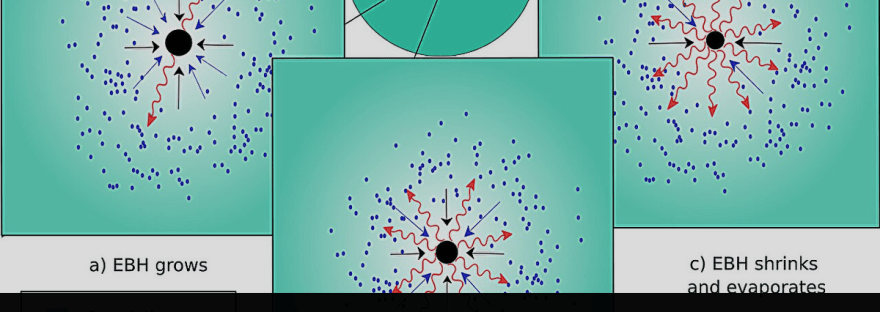
Editors have highlighted the following attributes while ensuring the content's credibility: fact-checked peer-reviewed publication trusted source written by researcher(s) proofread The GIST Add as preferred source Schematic illustration of the competing processes governing the evolution of an endoparasitic black hole (EBH) inside a compact star. The EBH simultaneously accretes baryonic matter from the stellar medium (black arrows) and captured dark-matter particles (blue arrows), while losing mass through Hawking radiation (red arrows). The three panels illustrate the possible regimes: (a) accretion dominates and the EBH grows, (b) accretion and Hawking evaporation balance and the EBH remains at about constant mass, and (c) Hawking evaporation dominates and the EBH shrinks and ultimately evaporates.
The relative number of arrows schematically represents the balance between the corresponding mass-flow rates. In case (b), EBH can have a mass as small as 40 metric tons. For primordial black holes formed in the early universe, the implications are dramatic.
A primordial black hole with a mass of around 10 12 kg has an evaporation timescale comparable to the age of the universe. Significantly lighter primordial black holes would therefore not be expected to survive until today.
The tiny black holes considered here, however, need not have existed since the early universe. They can form much later inside compact stars.
Neutron stars and white dwarfs can capture hypothetical ultraheavy asymmetric dark matter particles. Because these particles do not efficiently annihilate, they can accumulate at the stellar core, become self-gravitating and eventually collapse to form a tiny endoparasitic black hole.
Once formed, the black hole's fate is determined not by Hawking evaporation alone. Surrounded by dense stellar matter, it can gain mass by accreting ordinary matter from its host star and through the continued supply of dark matter.
Under favorable conditions, the calculations show that a black hole with an initial mass of only about 40 metric tons, roughly the mass of a loaded semitruck, can overcome Hawking evaporation and continue to grow. The key is dark matter.
A race between growth and evaporation A newly formed endoparasitic black hole does not automatically consume its host star. Its fate is decided by a competition: Accretion of stellar matter and continued dark matter feeding increase its mass, while Hawking radiation decreases it.
There is also a quantum complication. For an extremely small black hole, the usual description of accreting matter as a continuous fluid can break down.
The wavelength of an incoming particle can become comparable to the characteristic scale of the black hole, requiring a quantum description of particle absorption. As the black hole grows, the familiar fluid-like accretion regime eventually takes over.
The calculation follows both regimes while simultaneously accounting for stellar matter accretion, continued dark matter feeding and Hawking evaporation. How small can a growing black hole be?
The competition defines a critical black hole mass.
Discover more from ChuckysCarnage
Subscribe to get the latest posts sent to your email.

