
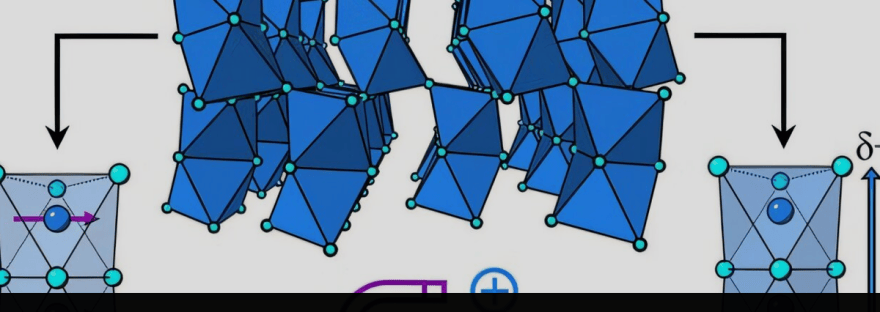
University of Warwick researchers have created a new material combining two properties, magnetism and electrical polarization, that scientists have struggled to bring together for decades—and crucially, it works close to room temperature. September 8, 2026 A tiny crystal tilt may bring greener magnetic memory closer to everyday devices by University of Warwick edited by Gaby Clark, reviewed by Robert Egan Gaby Clark Scientific Editor Meet our editorial team Behind our editorial process Robert Egan Senior Editor Meet our editorial team Behind our editorial process Editors' notes This article has been reviewed according to Science X's editorial process and policies. Editors have highlighted the following attributes while ensuring the content's credibility: fact-checked peer-reviewed publication trusted source proofread The GIST Add as preferred source The new material is a form of strontium manganite and gets around this by using a simple structural trick: pairs of atoms inside its crystal structure tilt together in a coordinated way.
This tiny shift is enough to generate an electrical charge across the material while also giving it a weak, switchable magnetism. Lees, Ivan Da Silva, Nicholas C. Materials with both magnetism and electrical polarization, known as magnetoelectrics, are highly prized because they allow magnetic information to be switched using an electric field rather than a magnetic one.
That could make future computer memory far more energy-efficient, an increasingly urgent problem as data centers and AI systems place growing demands on the power grid. The problem is that most magnetoelectric materials only work at extremely cold temperatures, ruling them out for everyday use. A simple tilt changes the picture The new material, reported in the journal Journal of the American Chemical Society, is a form of strontium manganite and gets around this by using a simple structural trick: Pairs of atoms inside its crystal structure tilt together in a coordinated way.
Crucially, the charge does not depend on the magnetism, unlike in most magnetoelectrics, where the two are locked together and only survive at extremely cold temperatures. Because the structural shift and the magnetism here are independently stable, both persist at far higher, and far more practical, temperatures. "Finding a material that combines magnetism and electrical polarization is hard enough on its own, but finding one that does this close to room temperature has been a real sticking point for the field," said Dr.
Struan Simpson, Department of Chemistry, University of Warwick. "What's exciting here is that the mechanism behind it is remarkably simple: A small, coordinated tilt within the crystal structure is all it takes.
That simplicity is what makes us confident this approach can be applied much more widely." Evidence and a broader blueprint Using high-resolution X-ray and neutron scattering, alongside detailed computer modeling, the team confirmed that this effect holds up to close to room temperature, far higher than in most materials of this kind. They also showed the effect could be strengthened by tweaking the material's chemistry, offering an uncomplicated way to fine-tune its performance.
"This isn't just about one material," added Professor Mark Senn, Department of Chemistry, University of Warwick. "It gives us a blueprint for looking at a whole class of structures that were previously overlooked for this kind of application.
The next step is exploring how far we can push these ideas, and how close we can get to a material that's genuinely ready for use in real devices." The team believes the same design trick could be applied to a much wider range of materials, opening the door to new energy-efficient technologies beyond the one studied here. Publication details Struan Simpson et al, Near-Room-Temperature Magnetoelectric Coupling Engineered through Inversion-Breaking Tilts in a Bulk Perovskite Polytype, Journal of the American Chemical Society (2026).
DOI: 10.1021/jacs.6c11283 Journal information: Journal of the American Chemical Society Dedicated to trustworthy science news. Full profile → Robert Egan Bachelor's in mathematical biology, Master's in creative writing.
Well-traveled with unique perspectives on science and language. Full profile → Citation: A tiny crystal tilt may bring greener magnetic memory closer to everyday devices (2026, September 8) retrieved 8 September 2026 from https://techxplore.com/news/2026-09-tiny-crystal-tilt-greener-magnetic.html This document is subject to copyright.
Apart from any fair dealing for the purpose of private study or research, no part may be reproduced without the written permission. The content is provided for information purposes only.
Discover more from ChuckysCarnage
Subscribe to get the latest posts sent to your email.

