When people wanted to create better artificial intelligence, they looked to the brain for inspiration. Now the tables are turning, and researchers are using AI models to better understand the brain. But how do we judge which AI models might accurately describe the computations the brain is performing?
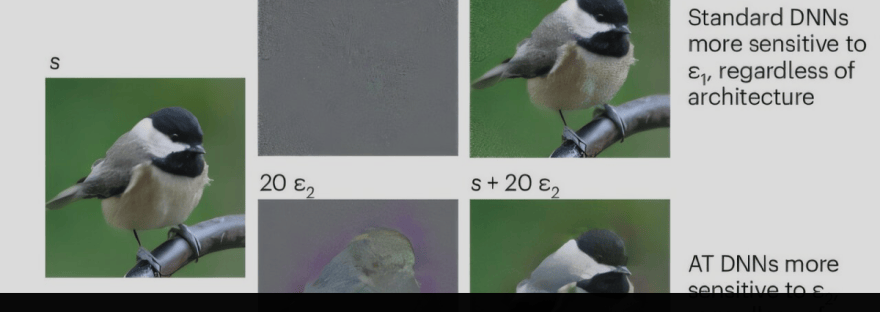
Why scientists are looking to provoke disagreement among AI brain models. Why scientists are looking to provoke disagreement among AI brain models by Columbia University edited by Sadie Harley, reviewed by Robert Egan Sadie Harley Scientific Editor Meet our editorial team Behind our editorial process Robert Egan Senior Editor Meet our editorial team Behind our editorial process Editors' notes This article has been reviewed according to Science X's editorial process and policies. Editors have highlighted the following attributes while ensuring the content's credibility: fact-checked peer-reviewed publication trusted source proofread The GIST Add as preferred source The concept of 'principal distortions' generalizes this approach to more than two models.
The two images on the right show the original image with each distortion added. DOI: 10.1038/s41583-026-01070-0 When people wanted to create better artificial intelligence, they looked to the brain for inspiration. Together with colleagues at Ben-Gurion University of the Negev and Université du Luxembourg, Nikolaus Kriegeskorte, Ph.D., a principal investigator at Columbia's Zuckerman Institute, explained emerging methods to evaluate which models best capture the computations the brain actually performs.
Kriegeskorte, also the Zuckerman Institute's director of cognitive imaging and a professor of psychology and neuroscience at Columbia, spoke about this research published as a review in Nature Reviews Neuroscience. Why have scientists developed all these models of how the brain works? Our brains have billions of neurons, and neuroscientists want to learn how all these brain cells work together to enable us to see, hear, think, plan and act in the world.
This has led researchers to develop many different theories about how our brains enable us to do these things. To test these theories, researchers implement them in computer models and see how the models behave.
Can these models perform human tasks? Yes, they can perform many tasks about as well as humans can.
But we want to find the models that achieve this performance using the same computations as the human brain. Consider face recognition.
Scientists often use natural stimuli, such as photos of actual faces, to test both people and models. The idea is to see how well the models do in the real world compared with real people.
But if different models all perform equally well when asked to distinguish one face from another, we have no way of deciding between them. Some of the models that solve the problem may be doing so in ways entirely different from how our brains solve the problem.
How are you distinguishing the competing models? We and others have started designing synthetic visual images that are optimized with AI methods to make the models disagree.
In these instances, different models make distinct predictions about human behavior. We can then show these images to people or animals in experiments and see which model is correct in terms of best matching their responses, or at least closer to being correct.
This way, we might find out what the brain is really doing. The gist is that neuroscientists are creating artificial stimuli specifically designed to make the models disagree in their predictions.
Such "controversial" stimuli—controversial among the models—put us in a good position to adjudicate between computational theories. What is an example of a controversial stimulus?
Let's say you are performing an experiment where people try to identify an image of a number. You could measure their accuracy and then compare how well the models do at predicting whether people think a given number is a 3 or a 7, for example.
Discover more from ChuckysCarnage
Subscribe to get the latest posts sent to your email.

