
On a mostly flat plain an hour north of Stockholm lies a collection of large burial mounds dating from an ancient culture at least 2,500 years old. These people were not Vikings; they were northern Germanic Goths, pagan polytheists worshiping the precursors of Odin, Freyr and Thor. September 10, 2026 Ancient Swedish Goths had surprisingly accurate calendars by Bruce Dorminey, Universe Today edited by Lisa Lock, reviewed by Robert Egan Lisa Lock Scientific Editor Meet our editorial team Behind our editorial process Robert Egan Senior Editor Meet our editorial team Behind our editorial process Editors' notes This article has been reviewed according to Science X's editorial process and policies.
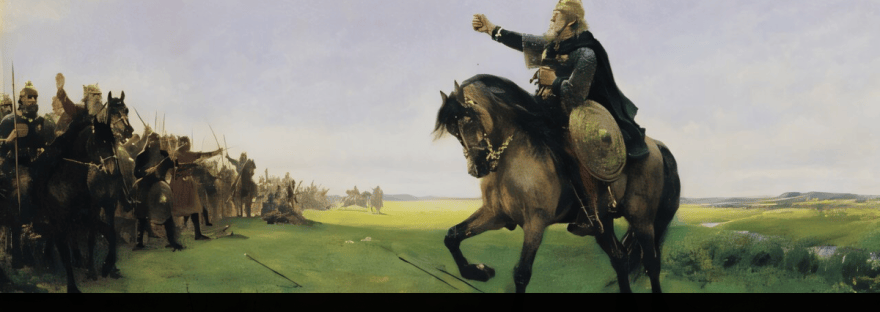
Editors have highlighted the following attributes while ensuring the content's credibility: fact-checked trusted source proofread The GIST Add as preferred source Scandinavian Goth on his horse. Peter Nicolai Arbo (1831–1892), Gizur and the Huns. National Museum of Art, Architecture and Design, Norway.
In truth, this ancient subgroup of Goths could probably have cared less about astronomy as we know it today. Yet, inexplicably, they were driven to make precise measurements of the sun and moon. They were obsessed with precisely timing nine days of gruesome midwinter human and animal sacrifices.
Despite such barbarism, they apparently believed that if they did not make these great midwinter sacrifices every eight years, the following eight years might bring a catastrophe. The sacrifices usually began at the height of winter from Feb. And at least one contemporary Swedish astrophysicist claims to have found these Goths' sacrificial calendar.
"I have discovered the calendar that regulates the dates for the Great Midwinter Sacrifice that took place every eight years," Goran Henriksson, an astrophysicist and former lecturer at Uppsala University in Sweden, tells me in Uppsala. In 2014, archaeologists discovered two long rows of poles that marked the northern limit for the rising of the full moon and the direction of the rising sun when it was time to start a sacrificial cycle, Henriksson tells me.
"The sacrifice at Old Uppsala took place every eighth year; the starting date was defined by the full moon that occurred between Jan. 26 in the Gregorian calendar," Henriksson writes in a paper presented at the 2014 meeting of the European Society for Astronomy in Culture.
By combining historical data and calculations of the dates of full moons, Henriksson has established the exact years of the eight-year cycle, including one that began in AD 852. The Burial Mounds north of Uppsala, Sweden.
But walking through these hills on a windy July afternoon, one can only imagine Visigoth culture as it once was. These people obviously had an appreciation of the natural world—including the celestial sphere—that completely eludes us at present.
Royal burial mounds Three "royal" burial mounds have been dated to AD 450–550 and oriented in such a way that they could have been used to regulate the sacrificial calendar, Henriksson writes. During archaeological excavations in 2013, two long rows of postholes were discovered, he writes.
An 850-meter-long (2,800-foot-long) row was oriented toward the northern limit for the rising midwinter full moon on the earliest date, Henriksson notes in his paper. The about 600-meter-long (2,000-foot-long) row was oriented toward the rising sun from Feb.
6 through 8, he writes. In fact, this sacrifice took place according to an eight-year cycle determined by the phases of the moon, which they could measure to six digits of accuracy.
For a period of nine days, one man and seven male domestic animals were sacrificed. And when the sacrifices were complete, one could see 72 bodies hanging upside down in a holy tree.
Incredibly, these burial mounds, which today are surrounded by at least 100 square miles (260 square kilometers) of flat plain, were at the time less than half a mile (0.8 kilometer) from what we now call the Baltic Sea. At that time, local sea level was 19.5 meters (64 feet) higher than it is today.
"The rays of the sun were reflected in the sea on both sides of the posts, and the shadows from the posts were aligned with the row," Henriksson writes.
Discover more from ChuckysCarnage
Subscribe to get the latest posts sent to your email.

