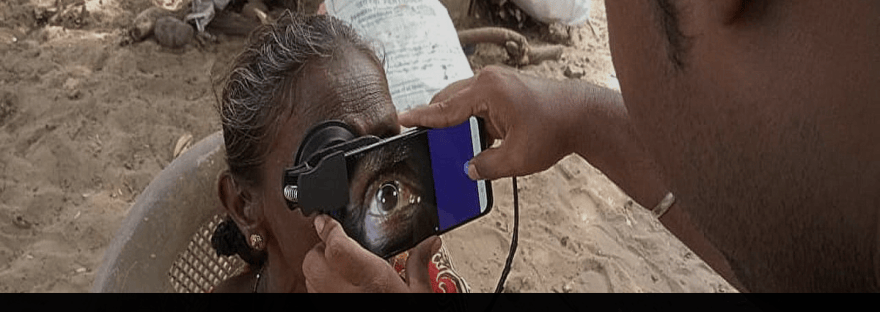
Researchers have found a high level of agreement between cataract referral decisions based on smartphone images reviewed remotely and those made by ophthalmologists examining patients in person at rural eye camps. Smartphones could be used to screen for cataracts and other eye problems by European Society of Cataract and Refractive Surgeons edited by Gaby Clark, reviewed by Robert Egan Gaby Clark Scientific Editor Meet our editorial team Behind our editorial process Robert Egan Senior Editor Meet our editorial team Behind our editorial process Editors' notes This article has been reviewed according to Science X's editorial process and policies. Editors have highlighted the following attributes while ensuring the content's credibility: fact-checked proofread The GIST Add as preferred source Photo from eye camp of the device being used.
The finding could make it possible for health workers to detect cataracts, pterygia (a fleshy growth on the white of the eye) and other eye diseases in people who live in remote rural areas and find it difficult to visit an ophthalmologist, either because of geographic barriers or because of age or infirmity. Prabhu Krishna Ravilla, a medical officer at Aravind Eye Hospital, Madurai, India, told the 44th Congress of the European Society of Cataract and Refractive Surgeons ( ESCRS) today (Sunday) that the study results could play an important role in tackling cataracts and preventing blindness in the future. "Cataract is still the major cause of global blindness, affecting nearly 100 million people worldwide, and it disproportionately impacts low-resource settings where access to eye specialists is severely limited," he said.
"In India and similar countries, the primary model for reaching rural communities has long been the 'eye camp'—temporary outreach clinics where ophthalmologists travel from urban hospitals to rural sites on fixed dates. But this model has serious constraints: It's expensive, logistically complex, entirely dependent on specialist availability and reaches only a fraction of those who need it. "An earlier Aravind Eye Hospital study found that eye camps screened only 7% of rural residents in the targeted region, with attendance dropping by 80% for those living more than 3 kilometers away—and among those who didn't attend, one-third needed cataract surgery.
Women, the elderly and the poorest communities are most underserved. The COVID-19 pandemic made things worse by halting outreach activities entirely." The device attached to a smartphone. Prabhu Krishna Ravilla Ravilla and his colleagues developed a small, portable attachment that clips onto an Android phone.
It contains a lens to magnify the front of the eye, two small white LEDs powered by the phone and a silicone scope that rests comfortably against the patient's eye socket, blocking ambient light and maintaining a fixed, consistent distance from the eye. The device is made in India and is inexpensive, costing less than £150, including the phone [see attached images].
It is paired with a mobile app used for telemedicine in areas with low bandwidth and is available in English and Tamil. "We hypothesized that a low-cost, easy-to-use smartphone imaging device could allow community health workers—people with minimal ophthalmic training—to capture diagnostic-quality eye images in the field, which could then be reviewed remotely by ophthalmologists.
This would decouple the need for a specialist to be physically present at every screening," he said. After three hours of training, the community health workers (CHWs) screened 1,093 patients at 19 rural eye camps in five towns near the city of Pondicherry in Tamil Nadu (Chengam, Tiruvannamalai, Cheyyar, Arani and Cuddalore), targeting rural villages around these towns.
Diagnoses and referral decisions were made by remote ophthalmologists and then compared with those made by ophthalmologists who saw the patients in person at the same eye camps. "The most clinically important finding was that when the remote ophthalmologist reviewed the smartphone images and the in-person eye camp doctor independently decided whether a patient needed to be referred to hospital for further care, they agreed in 96 out of every 100 cases," Ravilla said.
There was substantial agreement between the two doctors on the diagnosis of any cataract—they agreed in 89% of cases—mature cataracts (96%), immature cataracts (85%), no cataract, described as a clear crystalline lens (89%), and pseudophakia (identifying eyes that already had a lens implant) (97%). There was moderate agreement on pterygia (94%).
The CHWs learned quickly to screen each eye in less than 2.5 minutes, and agreement between doctors increased with image quality. "These findings challenge the assumption that specialist presence is necessary for accurate cataract screening.
They suggest a model where a trained ophthalmologist's time is used for diagnosis and decision-making—where it is most valuable—rather than travel and in-person examination," Ravilla said. "For patients, particularly in rural and underserved communities, door-to-door screening becomes imaginable.
"For policymakers and public health planners, it offers a potential path to scaling up cataract screening without a proportional increase in the specialist workforce. The platform integrates with existing community health worker infrastructure, works in low-bandwidth environments and has demonstrated patient acceptability.
It is also compatible with future AI-based grading, which could eventually reduce dependence on remote ophthalmologist review for initial triage." The researchers plan further investigations, including adding slit-beam and blue-light or dilated-eye images to improve diagnostic accuracy; these are included in the comprehensive eye examination considered the gold standard for detecting cataracts and other eye problems. They also plan to explore AI-assisted cataract grading and assess the platform's effectiveness and generalizability in other geographic and cultural settings beyond rural South India.
Medical Disclaimer: This article is for informational purposes only and does not constitute medical advice. Always consult with qualified healthcare professionals for medical decisions and treatment options.
Discover more from ChuckysCarnage
Subscribe to get the latest posts sent to your email.
 ChuckysCarnage