
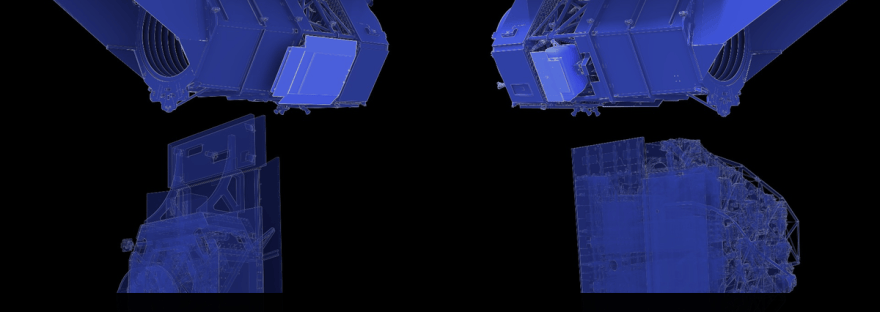
NASA’s Nancy Grace Roman Space Telescope team has successfully activated the Wide Field Instrument, a 300-megapixel infrared camera that will allow scientists to explore wide swaths of the cosmos very quickly without sacrificing exquisite detail. Roman’s planet imager — the Coronagraph Instrument — also stretched its digital, electronic, and mechanical “limbs” as part of an […]. Roman’s planet imager — the Coronagraph Instrument — also stretched its digital, electronic, and mechanical “limbs” as part of an initial test after waking up earlier this month.
These steps are part of a monthslong series of calibrations and tests, as Roman continues its million-mile journey to its destination at the second Lagrange point, L2. Sky-scanner comes online Each image taken by the Wide Field Instrument, or WFI, will capture a patch of the sky bigger than the apparent size of a full moon with all the sharpness of space telescopes like NASA’s Hubble. Its sweeping cosmic surveys will help scientists discover new information about planets beyond our solar system, untangle mysteries like dark energy, and map how matter is structured and distributed throughout the cosmos.
The mission’s broad, crisp view will also produce an exciting new resource for many additional scientific studies. Watch this video to learn more about the Roman Space Telescope’s Wide Field Instrument. NASA’s Goddard Space Flight Center, Music This is a huge milestone for the team at Goddard, our industry teams at BAE Systems, Inc.
And Teledyne, and our science centers,” said Josh Schlieder, the Wide Field Instrument scientist at NASA’s Goddard Space Flight Center in Greenbelt, Maryland. “There is much to do, but we are on our way to groundbreaking science.” Before the team could activate the WFI, they had to let it rest for 10 days to dry out and decontaminate with the detectors at a relatively warm (compared to their final operating temperature) minus 85 degrees Fahrenheit, or minus 65 Celsius. On the morning of Sep.
11, they turned off the instrument heater and let the WFI cool down to minus 225 Fahrenheit (minus 143 Celsius), at which point they could activate Roman’s 18 infrared detectors, which combined have a sensing area about the size of a laptop screen. Scientists and engineers in the launch support room at NASA’s Goddard Space Flight Center in Greenbelt, Md., celebrate the activation of Roman’s Wide Field Instrument.
NASA/Sophia Roberts Later that night, the team activated the calibration system, which they used the next morning to start sending test data through the instrument and down to engineers on the ground. On Saturday evening, the focus shifted to the element wheel — a system of filters, prisms, and other optics used to tune the wavelengths of light that reach the detectors and spread light from cosmic objects into individual colors — as engineers tested it in the absence of gravity for the very first time.
Finally, on Sunday morning, the team made sure the WFI’s focus mechanism functions properly — an important step since it will be used to focus the hundreds of thousands of images the instrument will take. While these activities were happening, the detectors continued to cool to their final temperature of about minus 300 Fahrenheit (minus 183 Celsius).
This test image captures the very first photons of starlight to reach the Wide Field Instrument on NASA’s Nancy Grace Roman Space Telescope. It was taken as an initial performance assessment with the detector array still stowed as it was for launch, far from best focus.
Roman’s primary science instrument has opened its eyes to the universe for the first time, revealing a sea of out-of-focus stars, each spread out over many thousands of pixels. The image, which zooms into one detector and zooms again to a single star in the insets, offers a baseline the Roman team will work from to align the telescope’s optics and tune the focus.
The team will soon activate the instrument’s fine-guidance system, which will mean Roman can lock onto targets. They’ll also focus the observatory, which will shrink each star’s light to appear as a crisp point, rather than the broad, donut-like features seen here (which appear as expected given the instrument’s present configuration).
Roman’s science images, which NASA expects to release by early 2027, will be much sharper and reveal the cosmos in exquisite detail. NASA’s Goddard Space Flight Center, Tyler Desjardins (STScI) All of these assessments confirmed the instrument is working as expected.
The mission remains on track to release Roman’s first science images by early 2027. Coronagraph in tip-top shape The Roman Coronagraph is a system of optics, masks, self-flexing mirrors, and sensors designed to demonstrate the most advanced technologies ever flown in space for directly imaging planets around other stars.
It will block the glare from stars and make it possible for scientists to see the faint reflected light from planets in orbit around them. Scientists and engineers at the Coronagraph Commanding Center at Caltech/IPAC in Pasadena, California, confirmed they can communicate with all of the instrument’s components: software, thermal control, mechanisms, cameras, and the avionics which drive all of these.
Essentially, operators on the ground ensured they could remotely flip all the switches that allow them to control the instrument, like the movable mechanisms that hold all of its masks, color filters, lenses, and prisms.
Discover more from ChuckysCarnage
Subscribe to get the latest posts sent to your email.
 ChuckysCarnage