
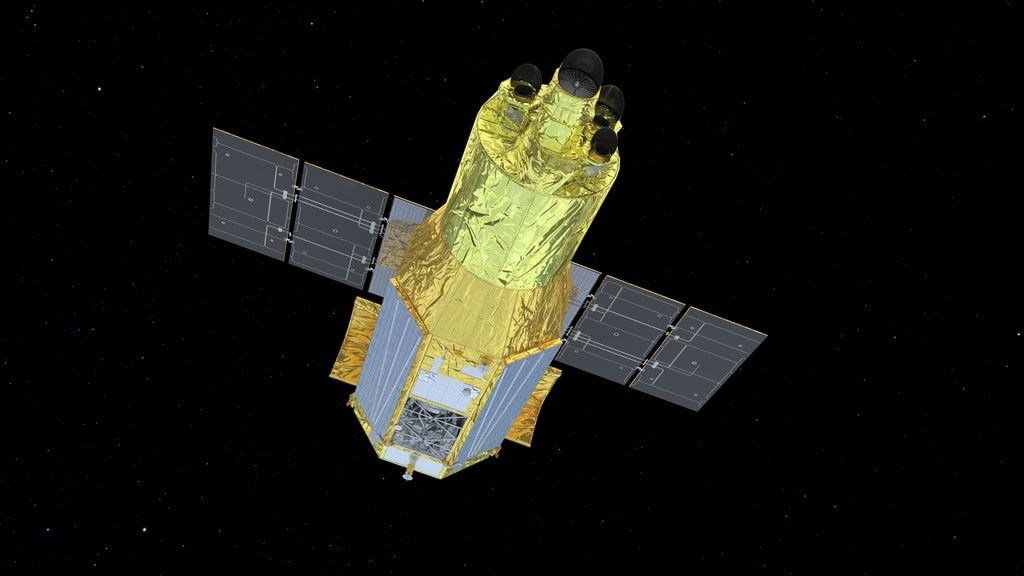
Using data from the Japan-led XRISM (X-ray Imaging and Spectroscopy Mission) observatory, astronomers have directly observed a giant star’s outflow, called a stellar wind, being captured by its compact companion and providing the power source for strong X-ray flares. The research is part of NASA’s exploration of the extreme universe to better understand how the […]. NASA-JAXA XRISM Mission Sees Pulsar Gathering Companion’s ‘Wind’.
“We’ve never before seen clear indications of wind plasma falling onto a compact object,” said Roi Rahin, a researcher at UMBC (University of Maryland, Baltimore County) and NASA’s Goddard Space Flight Center in Greenbelt, Maryland. “We can now test our understanding of these processes in much greater detail.” A paper describing the findings published Friday in the journal Science Advances. The target system is BP Crucis, a high-mass X-ray binary located about 13,000 light-years away in the southern constellation Crux.
The primary star, known as Wray 977, is a blue hypergiant about 40 times the Sun’s mass and 60 times its size. It’s so big, hot, and luminous that ionized gas constantly streams away from it, a phenomenon astronomers call a stellar wind. This artist’s concept of the BP Crucis system follows the pulsar on a passage through the dense stream of plasma flowing from its companion, a blue hypergiant 40 times the Sun’s mass.
During each four-day passage, the pulsar’s X-ray brightness flares as it pulls in some of the gas.
Discover more from ChuckysCarnage
Subscribe to get the latest posts sent to your email.
 ChuckysCarnage