
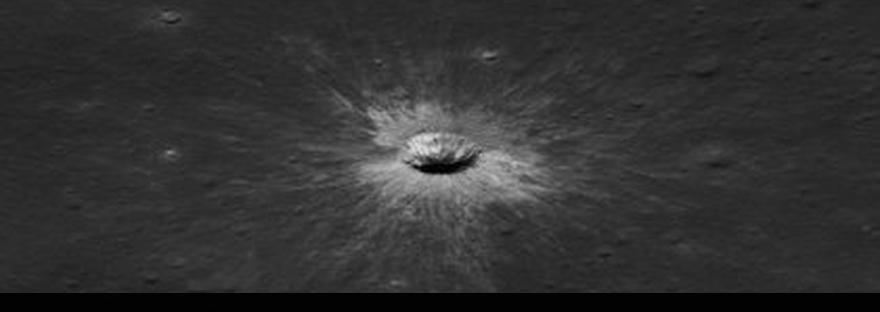
The impact crater was formed in 2024 when an object the size of a multi-story building crashed into our lunar companion. The resulting divot is about 728 feet wide and 141 feet deep. An image of the crater captured by NASA’s Lunar Reconnaissance Orbiter on March 3, 2026.
NASA The moon is rocking a massive new crater—and it’s the largest recently formed one that’s been found in the entire solar system. Researchers described the new feature, as well as changes to the lunar surface surrounding it, in two studies published September 16 in the journal Science Advances. Analyzing impact craters on the moon helps researchers learn more about our satellite and can inform plans to send humans and technology there.
The crater came to light in October 2025 when Robert Wagner, an image-processing specialist at the aerospace company Intuitive Machines, found a large bright spot surrounded by a dark halo in photos from NASA’s Lunar Reconnaissance Orbiter (LRO) camera system. That sort of composition suggests the surface material had been disrupted. “It was by far the most obvious impact debris pattern I’ve ever seen in one of these images,” Wagner says in a statement.
Left: the new crater, which is circled. Right: The same area before the impact. NASA Goddard / Intuitive Machines / Robert Wagner His suspicions were confirmed when he compared before-and-after images of the region.
The crater emerged on the moon’s eastern edge sometime between April 11 and May 22, 2024, the team found. At 728 feet wide, its diameter stretches just over the length of two football fields.
It’s also 141 feet deep, meaning three vertically stacked school buses could sit in it. Wagner and colleagues estimate that the feature was formed when an asteroid or comet around the size of a three- to six-story building struck the moon—an event estimated to occur just once every 132 years.
“A crater of this size should form on the moon only once per century, so we’re extremely lucky it formed during the lifetime of the LRO mission and that we are able to observe the region both before and after impact,” Tyler Powell, a planetary scientist at the Johns Hopkins Applied Physics Laboratory who co-authored the other study, tells Space.com ’s Samantha Mathewson. Researchers named the moon’s new hole for pioneering lunar scientist Tom McGetchin, who died in 1979.
Thermal images before and after the formation of the McGetchin crater. Researchers discovered a “cold spot” around the crater.
NASA Goddard / UCLA / JHU APL The LRO launched in 2009. For almost two decades, the orbiter has been collecting data on the moon’s topography, surface composition, temperature and radiation environment.
After Wagner first spotted McGetchin crater, follow-up observations with the LRO’s thermal instrument, Diviner, allowed researchers to identify a four-mile-wide area around the new feature that is around 16 degrees Fahrenheit cooler than its surroundings at night. According to Powell and colleagues, the chillier temperature is due to the regolith—moon dirt—getting fluffed up by the impact, reducing the material’s density and ability to retain heat.
Wagner and colleagues found that ejected material disturbed the surface more than 75 miles from the crater. That, combined with the expanse of the relatively frigid area, demonstrates the far-reaching effects of incoming space rocks, which have implications for people and technology that might roam that terrain.
“If we’re trying to send rovers or astronauts or build things on the moon, we want to understand the properties of the surface,” Powell tells New Scientist ’s Leah Crane. The opportunity to study the development and transformation of a large new crater is a fantastic way to do that from a distance, according to the outlet.
NASA is forging ahead with its plan to establish an enduring human presence on the moon, so scientists need to calculate the risk of debris from impacts hitting the agency’s future moon base, Mark Robinson, who co-authored the study Wagner worked on and is part of LRO’s camera team at Intuitive Machines, tells the Associated Press ’ Marcia Dunn. Quick fact: Another notable new crater On August 5, the moon gained another new divot, but this one wasn’t made by a natural phenomenon.
It was struck by a stray SpaceX rocket part. “Collisions are a pervasive physical process during planet formation and evolution,” Sarah T.
Discover more from ChuckysCarnage
Subscribe to get the latest posts sent to your email.
 ChuckysCarnage