
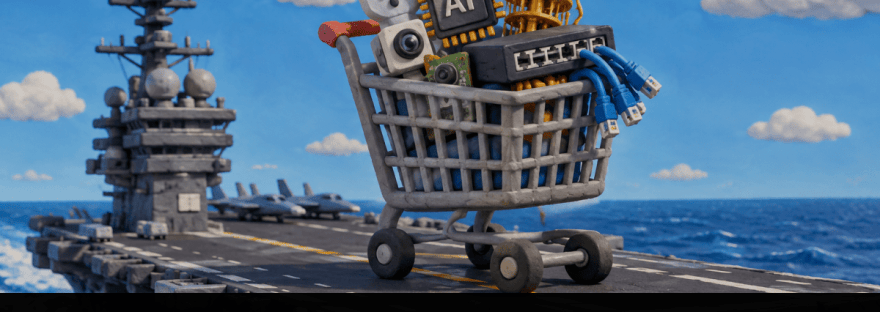
Navy CTO Justin Fanelli talks co-investing alongside VCs instead of funding early research himself, recent buys like a $562 million autonomous refueling deal, and the Navy's updated wish list — from AI to quantum — for where founders should be building next. Justin Fanelli, the Department of Navy’s chief technology officer, has spent the last three and a half years trying to make the U.S. Navy easier to do business with.
When we first talked to him last year, he described a shift away from what he called “your granddaddy’s government” — a “spaghetti chart” of entry points for startups — into something closer to a funnel, where companies that show strong results get pulled into the Navy’s technology base as enterprise services. This week, we caught up with him again on a video call, and this time, he wasn’t just looking again to further streamline the procurement process, he was sprinting, literally, to catch a flight he’d just been ordered onto with no destination shared. “You have an hour and 15 minutes to get on a plane,” Fanelli said, recounting what he’d just been told, speaking into his phone as he walked, the sun shining behind him.
“I’m like, ‘Where?’ Oh my God! And they were like, ‘We’ll figure [the logistics], we’ll tell you as you get there.’ And I’m like, ‘For more than overnight?’ And they were like, ‘Yes.’” As he was walking to his car, he was still unsure what he’d packed for or where he was headed. “I will figure that out in the next 20 minutes,” he said, sounding excited about the adventure ahead.
Fanelli reached out because the “demand signal” he sent to investors last year had only grown, and it was making an impact, he said. When the Navy first published its longer-term technology priorities, investors told him it changed how they thought about the Navy’s buying plans, which is part of why he’s doing it again — sharing a fresh list of what the Navy wants to buy in the next several years, this time vetted by a handful of (unnamed) venture investors before release. How much money the Navy actually puts to work each year depends on what counts as spending, Fanelli said.
“We spend in the $150 billion range every year,” he said, though he was careful to separate that number — total Navy purchasing — from something narrower, like direct equity investment. While most of that spending still flows through traditional channels, Fanelli said the Navy is trying to inch further toward what he calls co-investment — putting money behind companies alongside private capital rather than writing a check to an established prime contractor.
Taking an equity stake, he said, is the most aggressive version of that and remains rare. More often, co-investment means the Navy waits for companies to mature a product on their own before buying it, rather than funding early research itself.
The stage of company the Navy buys from has shifted, too. “We mostly buy Series D through F type companies,” Fanelli said, adding that the Navy used to fund its own early-stage research to cover the seed-through-Series-B gap.
It’s trying to hand that job to commercial investors instead, which is part of why the priorities document exists at all. “The cost of that, or the responsibility, is for us, if we’re not going to do it ourselves, to cast a cleaner signal,” he said.
As for recent purchases, Fanelli — a former Air Force cadet whose career has spanned roles across defense, intelligence, DARPA, and open source initiatives — rattled off a handful. A contract worth $562 million was awarded this month for the MQ-25 Stingray, an autonomous refueling drone that extends the range of manned fighter jets flying off carriers.
The Navy has also been buying edge compute hardware from Armada, described loosely as shipping containers packed with servers meant for ship or remote deployment. It brought in Gecko Robotics to handle inspection work that used to be done manually and dangerously; Fanelli said the move drew little pushback because almost nobody wanted that job in the first place.
Domino Data Lab is now running the Navy’s machine learning pipeline. And in a case Fanelli seemed to particularly enjoy sharing, the Navy swapped a defense contractor’s years-delayed shipboard camera system for commercial cameras paired with software from Applied Intuition, cutting roughly four years off the timeline and expanding to more ships than expected.
Given the Strait of Hormuz has been a flashpoint this year — tanker strikes, a seized vessel, ceasefires that have broken down over shipping-route disputes — it seemed worth asking whether any of that commercial technology is showing up there now. “I often don’t know what’s classified and unclassified because I’m normally talking to people with clearances,” he said, adding that he’d have to check.
(We’ll let you know if he gets back to us.) Interestingly, not many people sign off on a purchase like that, according to Fanelli. Buying decisions run through what he called a source selection committee, a small group rather than the sprawling review process outsiders might picture.
He described the goal as keeping the process merit-based rather than adding layers of approval.
Discover more from ChuckysCarnage
Subscribe to get the latest posts sent to your email.
 ChuckysCarnage