
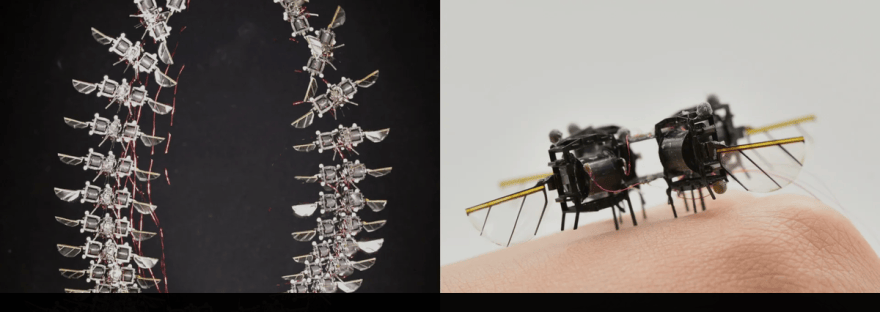
A new AI control system lets MIT’s tiny flying robot move with insect-like agility, boosting its speed by about 450 percent and allowing it to pull off 10 somersaults in 11 seconds. The technology could eventually enable miniature robots to search earthquake rubble and navigate dangerous spaces that conventional drones cannot reach. Science News from research organizations MIT’s tiny flying robot gets 450% faster with AI MIT’s tiny AI-powered flying robot can now move almost like an insect, performing rapid turns and 10 flips in just 11 seconds.
Right: Chen’s group has been building robotic insects for more than five years. Because of their small size, these robotic insects could potentially move through narrow spaces that larger drones cannot enter while avoiding walls, debris, and falling objects. Until recently, however, aerial microrobots have been far less nimble than the insects that inspired them.
They typically moved slowly and followed relatively simple flight paths. Researchers at MIT have now demonstrated a new approach that gives an insect-scale flying robot much greater speed and agility. The team developed an AI-based controller that allows the robotic bug to perform demanding aerial maneuvers, including repeated body flips.
Using a two-part control system designed to balance performance with computational efficiency, the researchers increased the robot's speed by about 450 percent and its acceleration by about 250 percent compared with their previous best results. The robot was agile enough to complete 10 consecutive somersaults in 11 seconds, even while wind disturbances tried to knock it away from its intended path. "We want to be able to use these robots in scenarios that more traditional quadcopter robots would have trouble flying into, but that insects could navigate.
Now, with our bioinspired control framework, the flight performance of our robot is comparable to insects in terms of speed, acceleration, and the pitching angle. This is quite an exciting step toward that future goal," says Kevin Chen, an associate professor in the Department of Electrical Engineering and Computer Science (EECS), head of the Soft and Micro Robotics Laboratory within the Research Laboratory of Electronics (RLE), and co-senior author of a paper on the robot.
Chen is joined on the paper by co-lead authors Yi-Hsuan Hsiao, an EECS MIT graduate student; Andrea Tagliabue PhD '24; and Owen Matteson, a graduate student in the Department of Aeronautics and Astronautics (AeroAstro); as well as EECS graduate student Suhan Kim; Tong Zhao MEng '23; and co-senior author Jonathan P. How, the Ford Professor of Engineering in the Department of Aeronautics and Astronautics and a principal investigator in the Laboratory for Information and Decision Systems (LIDS).
The research was published in Science Advances. AI Gives the Robot a Smarter Flight Controller Chen's group has spent more than five years developing robotic insects.
The team recently created a more durable version of their tiny robot, which is about the size of a microcassette and weighs less than a paperclip. This newer design has larger flapping wings that support more agile flight.
The wings are driven by soft artificial muscles that contract rapidly enough to produce extremely fast wingbeats. The physical design had improved, but the robot's controller remained a major limitation.
This controller acts as the robot's "brain," determining where the robot is and deciding how it should move. In earlier versions, a human had to tune the controller by hand.
For the robot to fly with the speed and aggressiveness of a real insect, the researchers needed a system that could handle uncertainty while rapidly solving complex control problems. A controller powerful enough to do that would normally demand too much computation to operate in real time, especially because the aerodynamics of such a lightweight flying machine are highly complex.
To solve this problem, Chen's group collaborated with How's team to develop a two-step AI-driven control system. The design combines the robustness needed for difficult, high-speed maneuvers with enough computational efficiency to work in real time.
"The hardware advances pushed the controller so there was more we could do on the software side, but at the same time, as the controller developed, there was more they could do with the hardware. As Kevin's team demonstrates new capabilities, we demonstrate that we can uses them," How says.
Teaching a Tiny Robot to Plan Difficult Maneuvers The first part of the system uses what is known as a model-predictive controller.
Discover more from ChuckysCarnage
Subscribe to get the latest posts sent to your email.
 ChuckysCarnage