Update on NASA Foundation Model Progress: To the Moon and Beyond September 2026 – NASA’s foundation model (FM) work began taking shape in 2023 when the NASA Interagency Implementation and Advanced Concepts Team (IMPACT) and IBM formed a collaboration to build a geospatial FM. Due to the Earth being so well studied and mapped out […]. Due to the Earth being so well studied and mapped out by remote sensing satellites, there is a plethora of data available for AI/ML training.
By summer 2023 the geospatial FM was released, Prithvi. Prithvi is a Landsat and Sentinel-2 data powered “geospatial” FM that can handle applications such as fire monitoring, flood analyses, and crop yield. This work eventually led to a formal “5+1” strategy from the NASA Office of the Chief Science Data Officer (OCSDO), envisioning an FM for each science division in the Science Mission Directorate, and an LLM to facilitate user access.
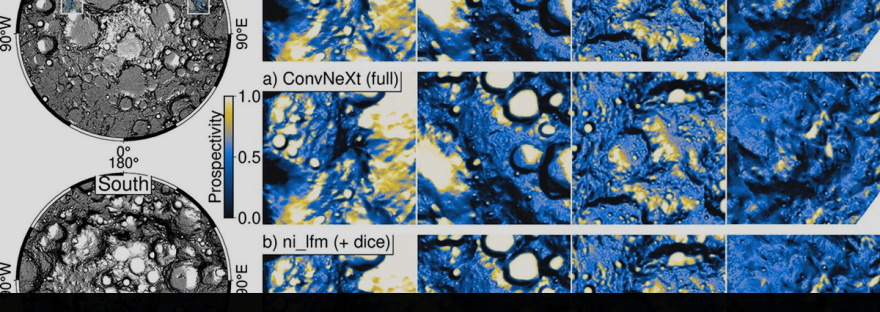
The Planetary Science Division has also begun their own FM projects. NASA ROSES-25 put out solicited calls for subject matter experts to join teams building a Lunar FM and Mars FM. And earlier this month the open-source, publicly available Lunar FM was released on Hugging Face and GitHub.
The Lunar FM, trained primarily on Lunar Reconnaissance Orbiter data, allows scientists to more quickly map craters, detect previously active volcanic features, estimate locations of ice, and there is the potential for use in future lunar exploration missions. Following on from these successes, work is now starting on two Mars FMs, one for the planetary surface and one for the atmosphere. This development will make extensive use of the experiences and lessons-learned from the previous FM efforts as well as scientific input from across NASA and the community.
Work is also progressing on the cross-divisional language-model component of the “5+1” strategy through INDUS, NASA’s suite of science-focused language models. The latest effort is integrating INDUS-SDE into the NASA Science Discovery Engine, where its encoder and semantic-retrieval capabilities are intended to improve how users search and discover scientific material.
Keep Exploring Discover More Topics From NASA Space Science and Astrobiology at Ames Technology Artificial Intelligence & Machine Learning Science & Technology Interest Group (AI/ML STIG) By providing structured, domain-specific AI education, the AI/ML STIG aims to accelerate NASA’s competitive advantage in AI-enabled space science, build… Artificial Intelligence for Science NASA is creating artificial intelligence tools to help researchers use NASA’s science data more effectively.
Discover more from ChuckysCarnage
Subscribe to get the latest posts sent to your email.

