
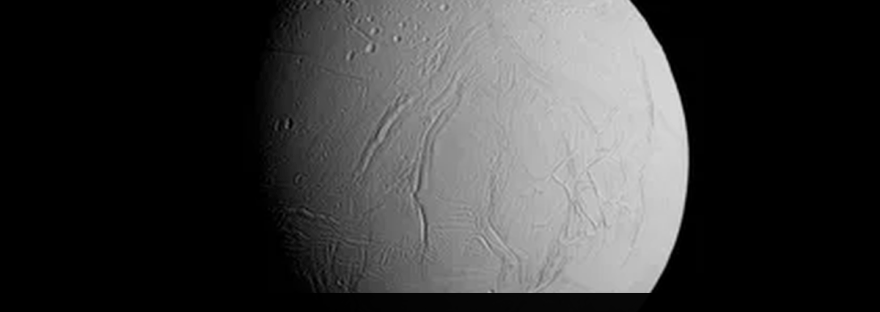
Enceladus is covered in ice, but that layer might hide a subsurface ocean. Researchers have long wondered if the salty body of water has the right conditions to host life, and now, a team suggests that an Earthly, heat-loving organism could thrive there. Enceladus is one of Saturn's 293 known moons.
NASA / JPL-Caltech / Space Science Institute Saturn’s moon Enceladus is one of astrobiologists’ favorite places in the solar system. Geysers spray salty ice from its south pole, hinting that the world harbors an underground ocean—and it might have the ingredients to spawn life. Now, two studies published September 25 in the journal Science Advances may have boosted our understanding of Enceladus’ potential habitability and our ability to assess it.
One revealed that an Earthly microbe can survive in conditions simulating the distant moon’s ocean. The other found that if life exists on the watery world, it might be easier to detect in samples than previously thought. “That is great news in the search for life,” says Frank Postberg, a planetary scientist at the Free University of Berlin and co-author of both studies.
Future spacecraft that go there and collect plume particles could identify signs of life “relatively easy with already available technology.” In the Earthly microbe study, Postberg and colleagues investigated Methanothermococcus okinawensis, a methane-producing, heat-loving archaeon found in deep-sea hydrothermal vents. They stuck it in a lab-made solution of water, salts, carbonates and powdered rock to mimic the environment of Enceladus’ seafloor, specifically vents there. The concoction had little oxygen and was a pH of 11, meaning it was highly alkaline, a condition that most known organisms can’t endure.
Okinawensis persisted. The microbes grew in the Enceladus-like slurry, adapting to the solution’s low level of carbon dioxide and using hydrogen produced by the water-rock reactions to fuel themselves.
That involves a biological process called methanogenesis, which makes methane as a byproduct. Another heat-loving microbe A recently discovered organism called the “fire amoeba” also survives at sweltering temperatures.
Unlike archaea, the amoeba belongs to the more complex group of life called eukaryotes, which have membrane-bound organelles, such as nuclei and mitochondria, in their cells. The fire amoeba can swim around at a sweltering 147 degrees, setting a new heat record for complex life.
“This was really a surprise to us,” Nozair Khawaja, a planetary scientist at the Free University of Berlin and co-author of both studies, says in the statement. “This was an experiment for which we did not expect such a successful outcome.” By demonstrating that methanogenesis is possible in the mock Enceladus ocean, the research “removes another barrier to the viability of microbial life there,” David Rothery, a planetary geoscientist at the Open University in England who wasn’t involved in the new research, tells the Guardian ’s Ian Sample.
The other study, meanwhile, investigated how challenging it would be to detect microbial life in material spewed from the distant moon’s subterranean ocean. Previous research suggests that after gas bubbles rise to the top of the ocean and pop, water vapor transports liquid droplets through cracks in the outer icy shell and into space, creating the famous plumes.
Using lab experiments and thermodynamic calculations, the researchers found that, contrary to previous ideas, these droplets freeze slowly, causing most of their dissolved ingredients to separate from one another. That means components like salts and organic materials within each frozen droplet would be organized in distinct locations, rather than being enmeshed.
Droplets rising through Enceladus' icy shell might freeze slowly, allowing their components to separate. Collisions with the frozen layer might cause the droplets to fragment.
FUB / Marie Dannenmann What’s more, droplets smacking into the icy shell at high speed on their way toward space would probably break up. That might produce spewed ice particles that each contain a single, concentrated material.
“In the plume grains, each separated compound can then be found at strongly elevated concentrations in a relatively small fraction of ice grains,” the researchers write in the study. “This is good news for future plume sampling missions investigating Enceladus’ promising habitability, provided that they can sample and analyze ice grains individually.” It’s also good news for scientists searching for aliens.
Some of these concentrated, isolated materials in Enceladus’ plume particles might be signs of life. How would spacecraft collect these informative icy tidbits?
Discover more from ChuckysCarnage
Subscribe to get the latest posts sent to your email.

