
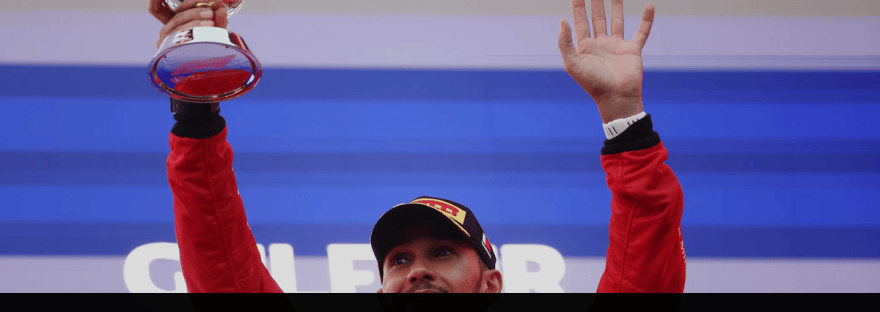
Lewis Hamilton finished P3 at the Bahrain Grand Prix in Malaysia, despite dropping behind by a minute during the race. Lewis Hamilton Ferrari Bahrain Hamilton reflects on 'bittersweet' podium in Sepang after comeback drive Lewis Hamilton finished P3 at the Bahrain Grand Prix in Malaysia, despite dropping behind by a minute during the race. The race in Sepang was initially delayed due to thunderstorms in the area, and the first race start procedure then got suspended as several drivers, including Hamilton, struggled to maintain speed on the initial formation lap.
When the race eventually got under way in mixed conditions, the Briton – who was second on the grid after a strong performance in Qualifying – dropped 15 places having opted to fit his Ferrari with slick soft tyres instead of intermediates. With the track not drying up as quickly as hoped, Hamilton dropped to P17 to run a minute behind the leading cars on the first lap – prompting the Scuderia to suggest a switch. The seven-time World Champion made the call from the cockpit to "gamble" and stay on the softs instead – a decision that ultimately saw him roar through the field to cross the line third behind Max Verstappen and Kimi Antonelli.
Hamilton finished third in Sepang after a "gamble" on soft tyres Asked how he felt after the race, Hamilton wasn’t sure. “I think it’s bittersweet," he said. "We had an opportunity and ultimately didn’t maximise it.
"I had a tough [time] at the beginning, but after the race got going and I managed to keep it on track — which, I’m telling you, was so, so hard. “I didn’t think that I’d be able to get back to third place, so I’m very, very grateful for that and very happy with it.” "Obviously we had the wrong call in the beginning, which was so difficult and I could see everyone just pulling away," he added. "I could see on the screen it was a minute down, and I thought that was kind of race over for us.
Max Verstappen and Lewis Hamilton liken the effects of a software bug that affected multiple cars before the Bahrain Grand Prix in Malaysia to a "Lego race". Image source, Getty Images Image caption, Lewis Hamilton's car lost all of its speed just before the race began By Andrew Benson F1 Correspondent Published 54 minutes ago Max Verstappen and Lewis Hamilton likened the effects of a software bug that affected multiple cars before the Bahrain Grand Prix in Malaysia to a "Lego race".
The problem led to several cars, including those of the two multiple world champions who were sharing the front row of the grid, not working in the wet conditions that preceded the race. A tropical downpour delayed attempts to get the grand prix under way for the best part of an hour.
And when the cars set off on formation laps behind a safety car to test the conditions, audiences were treated to the bizarre sight of many of them struggling to move. A bug in the software that mandates how the engines' electrical power can be used in wet conditions had been triggered by a combination of low engine speeds, low grip and specific aspects of the circuit layout.
Verstappen, who went on to take a dominant win that was his first victory of the year, said: "These engines are so complicated and a lot of software is implemented. "I triggered [the problem] first and then I looked in my mirror, I was like, 'Wait, are they waiting for me or what's going [on]…?' It was like the Lego race." Verstappen was referring to a show run in battery-powered Lego F1 cars that was held before the British Grand Prix in July.
Hamilton, sitting beside Verstappen in the post-race news conference after finishing third, interjected to say: "Yeah, we had the same speed. I had to stop on track and stop the car and engine and restart it.
I've never done that before." Verstappen added: "It was insane. Like, it's the Lego power.
At some point we were five-wide on the straight because we couldn't understand what was going on. "Then we did a lap and then I see eight other cars crawling still, and I saw you (Hamilton) by yourself crawling.
That's not what you want, right, for the sport." Mercedes driver George Russell, who retired from the race with an engine failure, said: "It didn't feel very F1." Nikolas Tombazis, the single-seater director for governing body the FIA said there would be a full investigation. The issue arose, he added, because, while the software had been tested, it had not been tested in these specific conditions.
Largely because there has been so little running in the wet this year. "Cars are complicated," Tombazis said.
"We would all like it to be simpler, but when you have electrical energy and combustion energy all working together, and obviously when you want to ensure that there's sporting fairness between the teams, that is complicated. "We haven't done a full debrief of the situation and see how we can avoid such an issue.
Every race, we have a long debrief afterwards, where we identify criticalities. "Obviously, that was a major criticality, and we need to make sure we avoid it.
Can I guarantee it will never happen again? This specific problem, yes.
A problem, no, but we will do our best to avoid it, of course." This is far from the first issue created by the huge complexity of the latest hybrid engines introduced this year, with their near 50-50 split between internal combustion and electrical power. Because the engines are fundamentally energy starved, and so cannot deploy their full combined power output at all times, a series of complexities were added into the management of the engines to try to sticking-plaster solutions.
Many of these led to the counter-intuitive driving about which many of the sport's stars have been complaining all season – and more changes have been added since. Off-track conversation has been dominated by this all year, and rules are changing for next year to alter the energy split to try to ameliorate the issue.
Discover more from ChuckysCarnage
Subscribe to get the latest posts sent to your email.

