
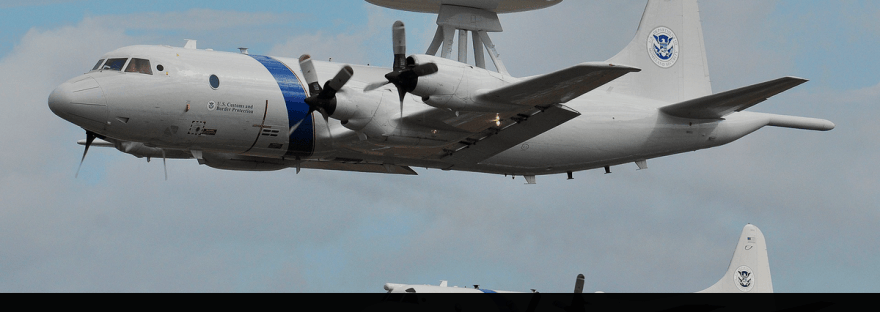
Customs and Border Protection was the only operator of P-3 AEW aircraft with their radar domes on top, using them to hunt drug smugglers. A CBP P-3 AEW (in front) flies together with a P-3 LRT (behind). Customs and Border Protection (CBP) has retired the last of its P-3 Airborne Early Warning (AEW) aircraft.
The AEW version is instantly recognizable from the saucer-like radar dome on top, as seen on other AEW types like the E-2 Hawkeye and the E-3 Sentry. CBP was the only operator of this variant of the P-3 Orion and reportedly have been the only law enforcement agency to fly any kind of dedicated AEW plane. The retirement of these aircraft comes at a time when American AEW assets, in general, are under heavy strain by demands globally.
CBP officially retired its final P-3 AEW on September 30, 2026, after a final flight from National Air Security Operations Center Jacksonville (NASOC Jacksonville), in Jacksonville, Florida. CBP has also flown Long Range Tracker (LRT) variants of the P-3, configured for more traditional maritime surveillance missions. The current plans for the LRT aircraft, and whether their sunset may also be on the horizon, are not immediately clear, and TWZ has reached out for more information.
Orions of all types have been steadily disappearing from service with the U.S. Military and elsewhere across the U.S. Government as the aging aircraft become more difficult to operate and maintain.
End of the Road: AMO’s Iconic P-3 Dome Takes Its Final Flight! On September 30, 2026, the distinct silhouette of a four-engine turboprop carrying its massive rotating radar dome touched down for the final time at the National Air Security Operations Center in Jacksonville.
Our… pic.twitter.com/doT9TZYJzD — CBP AMO (@CBPAMO) October 1, 2026 “Our Jacksonville-based P-3 AEW fleet has served as a cornerstone of America’s outer-layer border security,” according to a brief announcement from CBP about the retirement on social media. “Its crews flew far beyond our borders, providing wide-area surveillance across the Caribbean, Gulf of America [Gulf of Mexico], and the transit zones of Central and South America, helping detect and track threats before they could reach the United States.” By all indications, including official CBP sources, the P-3 AEW fleet consisted of eight aircraft at its peak.
There is a confusingly worded 2014 CBP press release that mentions an “11th and final Lockheed Martin P-3 Airborne Early Warning (AEW) aircraft overhaul,” but that figure looks to also include three of the six LRT versions. The same release says that CBP only had 14 P-3s of all types at that time.
What was then known as the U.S. Customs Service (USCS) first began operating the P-3 AEW version in the late 1980s.
The aircraft were converted from second-hand maritime patrol variants of the Orion. The first example had started life as a P-3B for the Royal Australian Air Force (RAAF).
Navy P-3s were also converted. A picture of a P-3 AEW in USCS service circa the late 1980s.
CBP The initial three P-3 AEWs were equipped with the AN/APS-138 radar. The same radar was used on early E-2C Hawkeye airborne early warning and control aircraft operated by the U.S.
Navy, as well as several other armed forces internationally. “The Customs Service had previously borrowed U.S.
Navy E-2Cs to meet its antinarcotics surveillance requirements, but required an aircraft with longer range and on-station time,” according to a 2006 report from Forecast International. “In June 1989, the U.S.
General Accounting Office issued a report on the drug interdiction P-3B AEW aircraft.
Medical Disclaimer: This article is for informational purposes only and does not constitute medical advice. Always consult with qualified healthcare professionals for medical decisions and treatment options.
Discover more from ChuckysCarnage
Subscribe to get the latest posts sent to your email.

