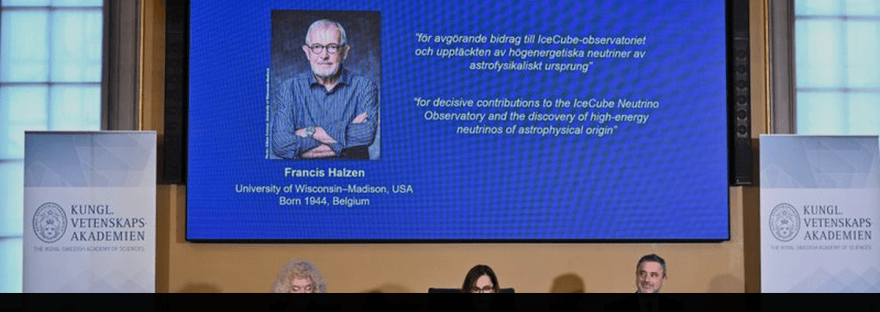
Belgian-American Particle physicist Francis Halzen won the 2026 Nobel Prize in Physics for "decisive contributions to the IceCube Neutrino Observatory and the discovery of high-energy neutrinos of astrophysical origin", the award-giving body said on Tuesday. By Reuters 6 Oct 2026 Members of the Nobel Committee for Physics, Eva Olsson, Ellen Moons, and Mark Pearce speak during a press conference to announce physicist Francis Halzen as recipient of the 2026 Nobel Prize in Physics, at the Royal Swedish Academy of Sciences, in Stockholm, Sweden, 06 October 2026. Halzen was awarded the 2026 Nobel Prize in Physics 'for decisive contributions to the IceCube Neutrino Observatory and the discovery of high-energy neutrinos of astrophysical origin', according to the Nobel Committee for Physics.
EPA/CHRISTINE OLSSON SWEDEN OUT Dive Deeper Speed Read Listen Dive Deeper The winners of the Nobel physics prize are selected by the Royal Swedish Academy of Sciences and receive a prize sum totalling 12 million Swedish crowns ($1.2 million), which is shared among the winners if there are several. The Nobel Prizes were established under the will of Swedish inventor and entrepreneur Alfred Nobel, whose fortune was built in part on the invention of dynamite. First awarded in 1901, the prizes honour achievements in science, literature and peace, with the economics award added later by Sweden's central bank.
Physics occupied a prominent place in Nobel's will and the prize remains one of the discipline's highest distinctions. Over the decades it has recognised discoveries that have fundamentally reshaped humanity's understanding of the universe. Among past laureates are some of the most celebrated figures in science, including Albert Einstein, Marie and Pierre Curie, Max Planck and Niels Bohr, whose work helped establish the foundations of modern physics.
Last year's physics prize was awarded to US-based scientists John Clarke, Michel Devoret and John Martinis for experiments that demonstrated the principles of quantum physics in action, research seen as helping to advance the next generation of computing and other digital technologies. The award was the second of this year's Nobels to be unveiled, following Monday's medicine prize announcement, with chemistry next on Wednesday. Nobel medals are presented to the winners by Sweden's King Carl XVI Gustaf at a ceremony in Stockholm on December 10, the anniversary of Alfred Nobel's death.
Belgian physicist worked to build Antarctic observatory that tracks neutrinos from deep space. Listen (3 mins) Save Share Francis Halzen wins Nobel Prize in Physics for work on ‘ghost particles’ on social media Share Add on Google Eva Olsson, Ellen Moons and Mark Pearce sit in front of a screen displaying Francis Halzen as the recipient of the 2026 Nobel Prize in Physics at the Royal Swedish Academy of Sciences in Stockholm, Sweden, on October 6, 2026 [AFP] By Staff, AP and Reuters Published On 6 Oct 2026 6 Oct 2026 Belgian physicist Francis Halzen has won the 2026 Nobel Prize in Physics for creating a giant detector in Antarctica that captures neutrinos, the so-called “ghost particles” from space that scientists believe offer clues to how the universe evolved.
The Royal Swedish Academy of Sciences announced the prestigious award in Stockholm on Tuesday, crediting Halzen with a central role in building the IceCube Neutrino Observatory. Recommended Stories list of 3 items list 1 of 3 Is there life on another planet?
Scientists find the strongest evidence yet list 2 of 3 Have scientists discovered a dark matter particle? List 3 of 3 Nobel medicine prize honours US and German scientists for optogenetics work end of list The neutrino interactions collected by the observatory provide information about how high-energy neutrinos are created and may even reveal previously unknown phenomena, the Academy said.
“It was a great surprise, and I obviously didn’t expect it,” Halzen said, speaking to the committee by phone from Italy, in a call broadcast at the news conference to announce the winner. The 82-year-old said it was predicted before that he would win the Nobel Prize, but the announcement still made him feel “strange”.
“I am working on a proposal, and I hope that this prize will help getting it approved,” he said to chuckles from the audience. ‘Information from the cosmos’ Neutrinos have nearly no mass and carry no electric charge, so they can cross between planets, stars and human bodies without being altered, making them rare and hard to catch.
There are roughly 100 trillion solar and cosmic neutrinos that pass through our bodies every second. Halzen first proposed the IceCube project in 1988, realising that the clear ice beneath the South Pole could act as a detector, so on the rare occurrence a neutrino strikes an atomic nucleus, it gives off a flash of light that buried sensors can record.
The awards are followed by an elaborate banquet at Stockholm City Hall. The peace prize, the only Nobel not presented in Sweden, is awarded separately in Oslo.
($1 = 10.0329 Swedish crowns) Nobel laureates https://www.reuters.com/graphics/NOBEL-PRIZE/gdvzgwgejpw/ (Reporting by Niklas Pollard, Marie Mannes and Johan Ahlander in Stockholm; additional reporting by Simon Johnson, Anna Ringstrom and Greta Rosen Fondahn in Stockholm, and Terje Solsvik in Oslo; Editing by Alex Richardson and Kevin Liffey) World.
Discover more from ChuckysCarnage
Subscribe to get the latest posts sent to your email.

