
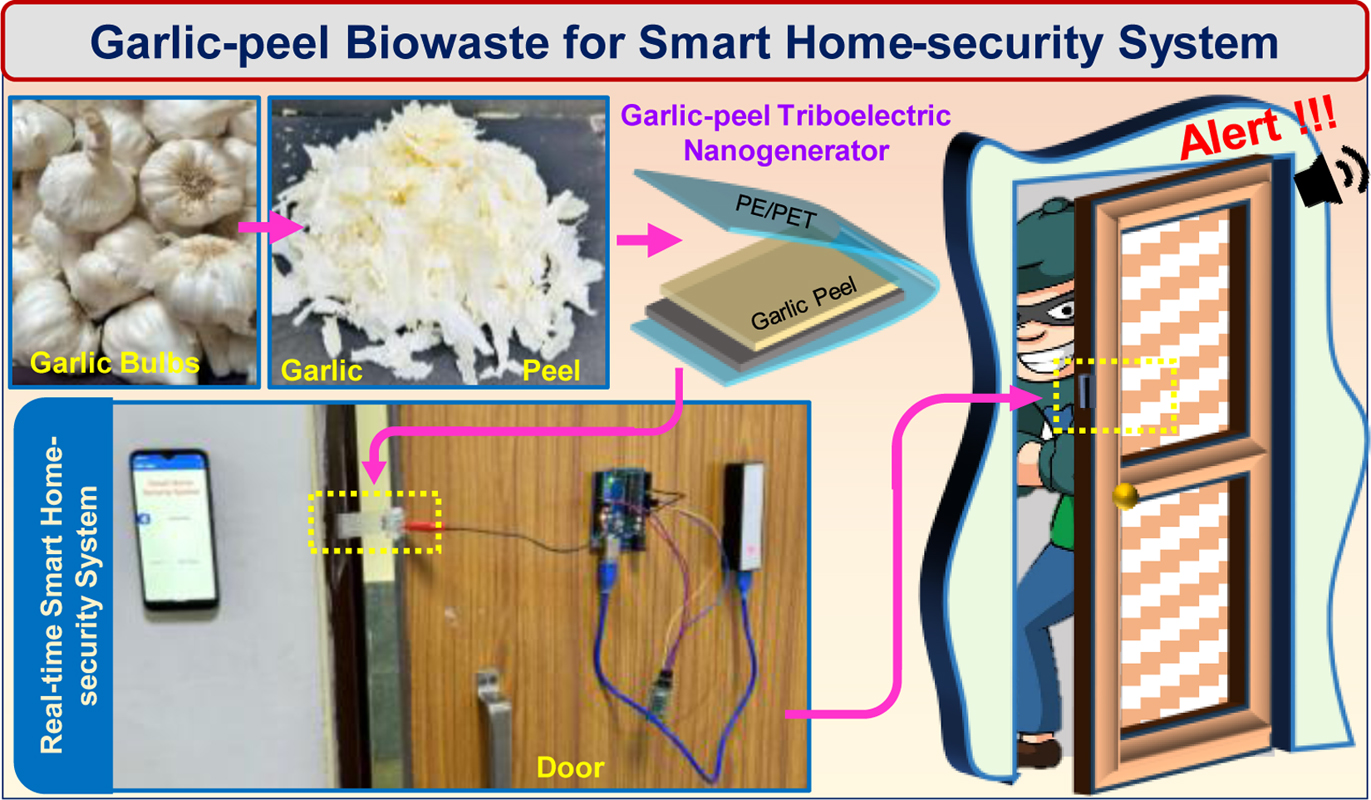
Most home security sensors require a chemical battery or external power source to operate, which can be a point of weakness. If the battery in a window or door sensor …. Introducing the Garlic-Powered Door and Window Sensor.
If the battery in a window or door sensor dies overnight and nobody is there to swap it, it might miss that one intruder or mess up your carefully curated home automation system. In that sense self-powered sensors are rather interesting, such as this one by [Manas Tiwari] and [Deepak Bharti] that is based around the triboelectric effect. The research article is sadly paywalled, but the IEEE Spectrum article covers all the salient details.
The sensor uses ground up garlic peel for the positive side of this triboelectric nanogenerator (TENG) as they call it, with a sheet of polyethylene (PE) forming the negative side. Once installed on a door frame, opening said door generates about 210 VAC with a 45 µA short circuit current. A dual-side layer of garlic peel bumps this up to 400 VAC and 65 µA.
As installed, the researchers used this generated current to detect changes using a separate MCU running off a powerbank, which obviously does not really solve the ‘running out of charge’ issue.
Discover more from ChuckysCarnage
Subscribe to get the latest posts sent to your email.

