
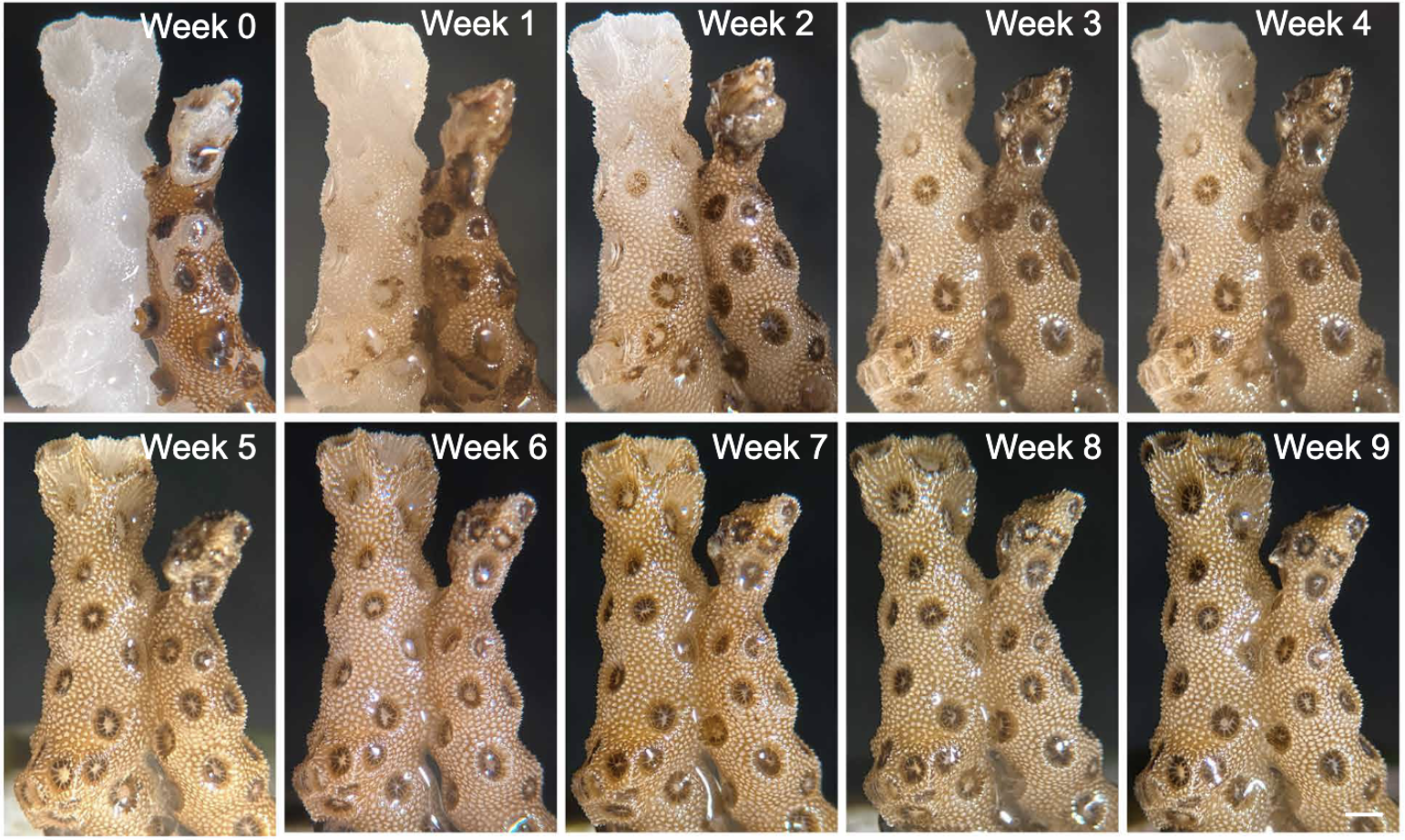
Coral bleaching is a major problem for ocean ecosystems as the ocean gets warmer. Researchers at Stanford have found a new method for regenerating bleached corals. Scientists working on coral ….
Spreading Life to Bleached Coral. Scientists working on coral found that when they had a bleached and healthy example accidentally touching in the lab, the symbionts from the healthy coral that make its food were able to spread to the bleached coral, reviving it in a matter of weeks. Contact was only required for one week, although three days was sufficient in a few cases.
The effect only seems to work with corals of the same genet as the healthy corals of other genets just take over the bleached coral antagonistically. This is particularly exciting, as areas where not all coral has bleached may indicate the presence of symbionts that are more heat tolerant, and being able to spread these symbionts to their neighbors quickly can greatly speed up the process of coral regeneration and save the reef. Coral reefs are some of the most vibrant ecosystems in the ocean, so if you save the coral, you can save many other species as well that rely on them.
NASA scientists have finally uncovered why asteroid Bennu loses heat so quickly despite being covered in massive boulders. Samples returned to Earth reveal that its rocks are filled with hidden cracks, solving a mystery that has puzzled researchers for years.
NASA solves a strange mystery hidden inside asteroid Bennu’s boulders. This specimen shows the most common types of crack networks observed in Bennu samples.
One has an extensive and connected framework of curved cracks, whereas the other has sparse, straight, and flat fractures. Instead of the relatively smooth terrain that earlier observations had suggested, the spacecraft found a rugged landscape dominated by enormous boulders, with very few areas suitable for collecting samples.
"When OSIRIS-REx got to Bennu in 2018, we were surprised by what we saw," said Andrew Ryan, a scientist at the University of Arizona’s Lunar and Planetary Laboratory, who led the mission’s working group responsible for analyzing the physical and thermal properties of its samples. "We expected some boulders, but we anticipated at least some large regions with smoother, finer regolith that would be easy to collect.
Instead, it looked like it was all boulders, and we were scratching our heads for a while." The discovery was especially confusing because of what astronomers had previously learned about Bennu’s ability to retain heat.
If you’d like to explore how the coral is doing near you, perhaps you should try an open ROV or a bionic jellyfish.
Discover more from ChuckysCarnage
Subscribe to get the latest posts sent to your email.

