
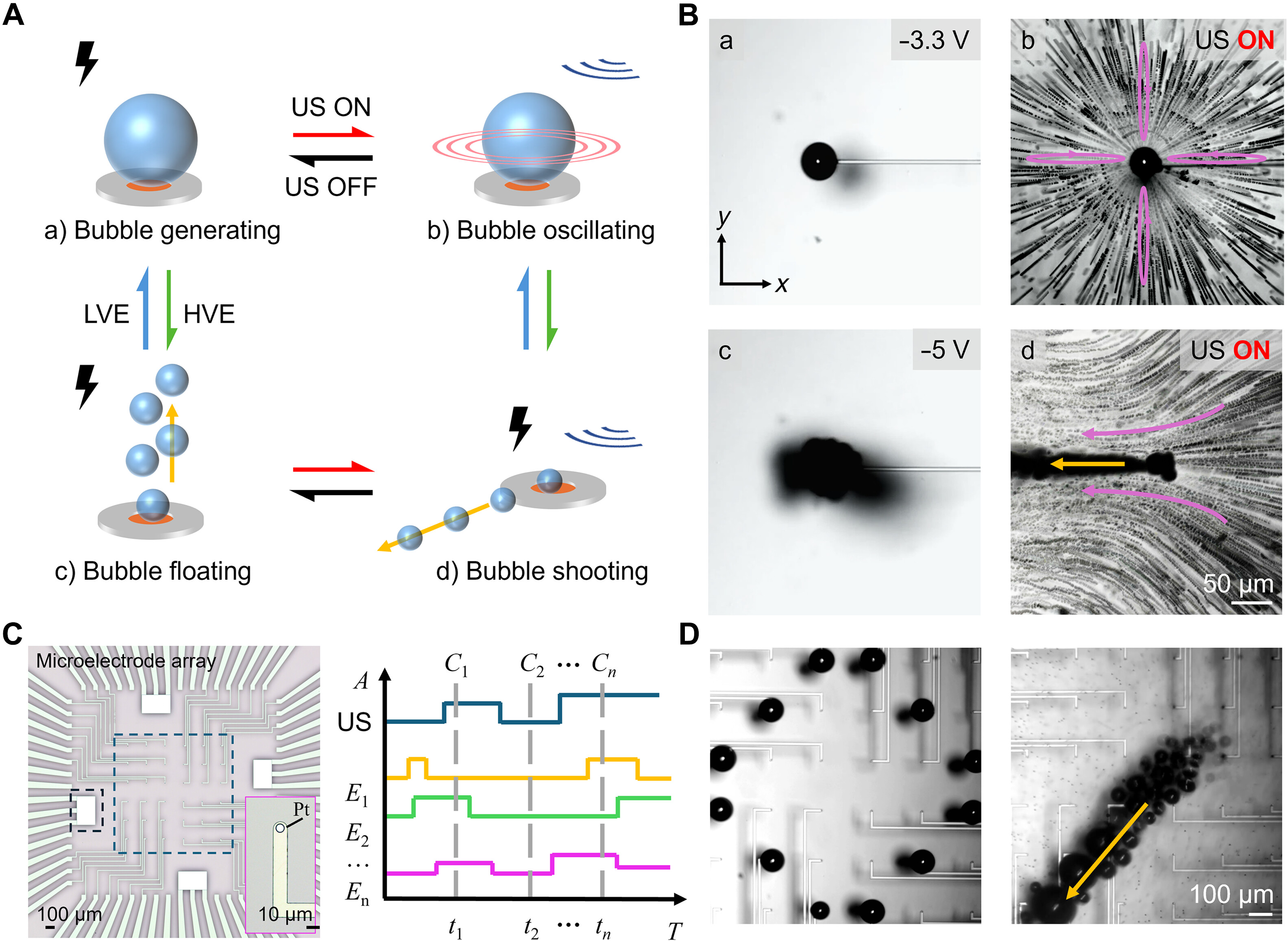
Although we generally do not look at bubbles in fluids as more than a curiosity – if not an outright annoyance – in certain contexts they can be very useful. Using Ultrasound and Microbubbles to Make Tiny Devices. If you can namely control their formation and position, you can use them in small systems to control actuators and dynamically affect acoustic systems.
The main issues here are that controlling their formation, lifetime and controllability remain hard to solve. Sought to address, with a recent study published in Science Advances covering their approach using ultrasound-driven, electronically programmable microbubbles. There’s also a Cornell press release article about their findings, which uses a new device that produces hydrogen bubbles along a grid of electrodes, before using ultrasound to steer them around.
Using this chip-like device they claim to be able to control the 10-100 micron sized bubbles, with the ultrasound matching the resonant frequency of the target bubble. With each bubble size having its own resonant frequency, this allows for individual control by varying the induced oscillations. Although in the demonstrated 2D setup this microbubble approach works well, it still requires a fairly bulky bench top setup around it which would need to be scaled down to be more practical.
Discover more from ChuckysCarnage
Subscribe to get the latest posts sent to your email.

