
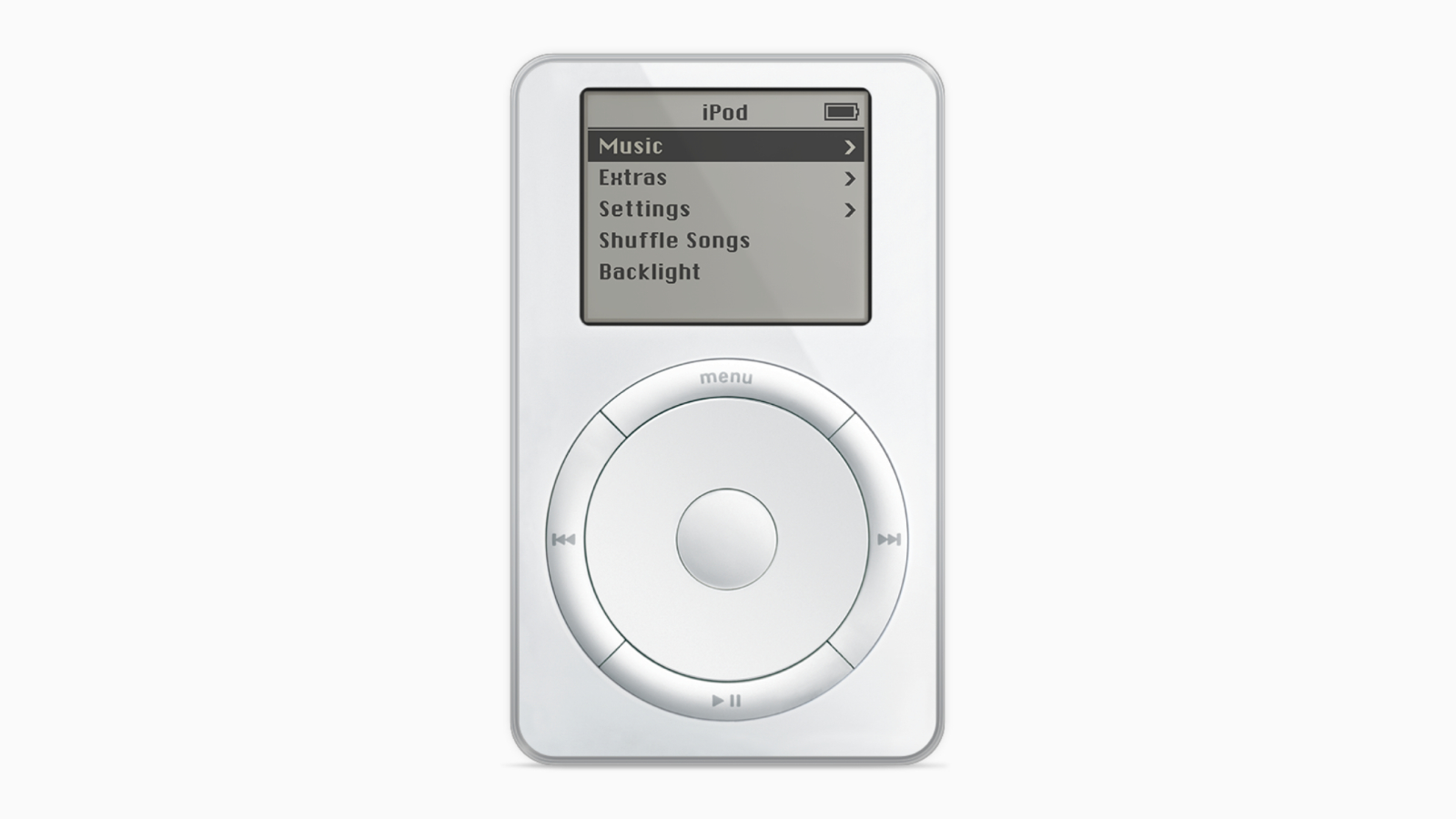
Apple today marks 25 years since the introduction of the original iPod, one of the company’s most significant products and a major contributor to its expansion beyond the Mac. Steve Jobs unveiled the first iPod on October 23, 2001, at a small press event in the Town Hall auditorium at Apple’s Infinite Loop headquarters. Advertised as offering "1,000 songs in your pocket," the device combined a 5GB hard drive with a monochrome LCD display, a mechanical scroll wheel, and up to 10 hours of battery life.
The original model cost $399 and required a Mac with iTunes. Its FireWire connection transferred music and charged the battery, while automatic synchronization copied songs and playlists from the user’s iTunes library. Apple said that an entire CD could be transferred in under 10 seconds and a collection of 1,000 songs in less than 10 minutes.
The hard drive could also store documents and other files. Ahead of the announcement, Apple invited the press to the unveiling of a "breakthrough digital device," specifying that it was not a Mac. Reports variously suggested a music player, a home stereo accessory, or a handheld device with handwriting recognition.
Rumor roundup published two days before the event included the name "iPod." The announcement received a mixed response. Our original coverage is still available, along with reader comments questioning the device’s price, Mac-only compatibility, and significance.
One reader described it as "far from revolutionary," while another wrote, "all this hype for something so ridiculous!" The iPod went on sale on November 10, 2001, with readers reporting that they lined up to purchase it. Early forum discussions included complaints about fingerprints on the polished rear enclosure, charging temperatures, and sound quality, alongside a host of positive impressions from owners.
Hardware revisions followed in quick succession. The second-generation iPod adopted a touch-sensitive scroll wheel, while the third-generation model introduced the 30-pin Dock Connector in 2003.
The full-size iPod gained a color display in 2004 and video playback in 2005. The iPod mini was announced in January 2004, representing the first extension of the product line.
It featured a smaller anodized aluminum enclosure in silver, gold, pink, blue, or green, and introduced the Click Wheel, which integrated playback buttons into the touch-sensitive scrolling surface. Apple adopted the same control for the fourth-generation full-size iPod later that year.
In 2005, Apple introduced both the iPod shuffle and iPod nano. The shuffle omitted a display and offered a smaller, simpler music player, while the nano replaced the mini with a thin design based on flash storage.
Later iPod nano models added video playback, a video camera, and a touchscreen. The square sixth-generation model, introduced in 2010, could be worn on the wrist using third-party watch straps.
By April 2007, Apple had sold 100 million iPods, less than six years after the first model reached customers. By its 10th anniversary in 2011, sales had exceeded 304 million units.
The iPod touch arrived in September 2007, several months after the first iPhone went on sale. It featured a 3.5-inch Multi-Touch display, Wi-Fi, and Safari, requiring a cellular plan.
Apple discontinued the iPod classic in September 2014, five years after its final hardware revision. The iPod nano and iPod shuffle followed in July 2017, leaving the iPod touch as the sole model.
The seventh-generation iPod touch received an A10 Fusion chip and up to 256GB of storage in May 2019. It remained on sale without further hardware updates until May 10, 2022, when Apple announced its discontinuation and said it would be available while supplies lasted.
Discover more from ChuckysCarnage
Subscribe to get the latest posts sent to your email.

