
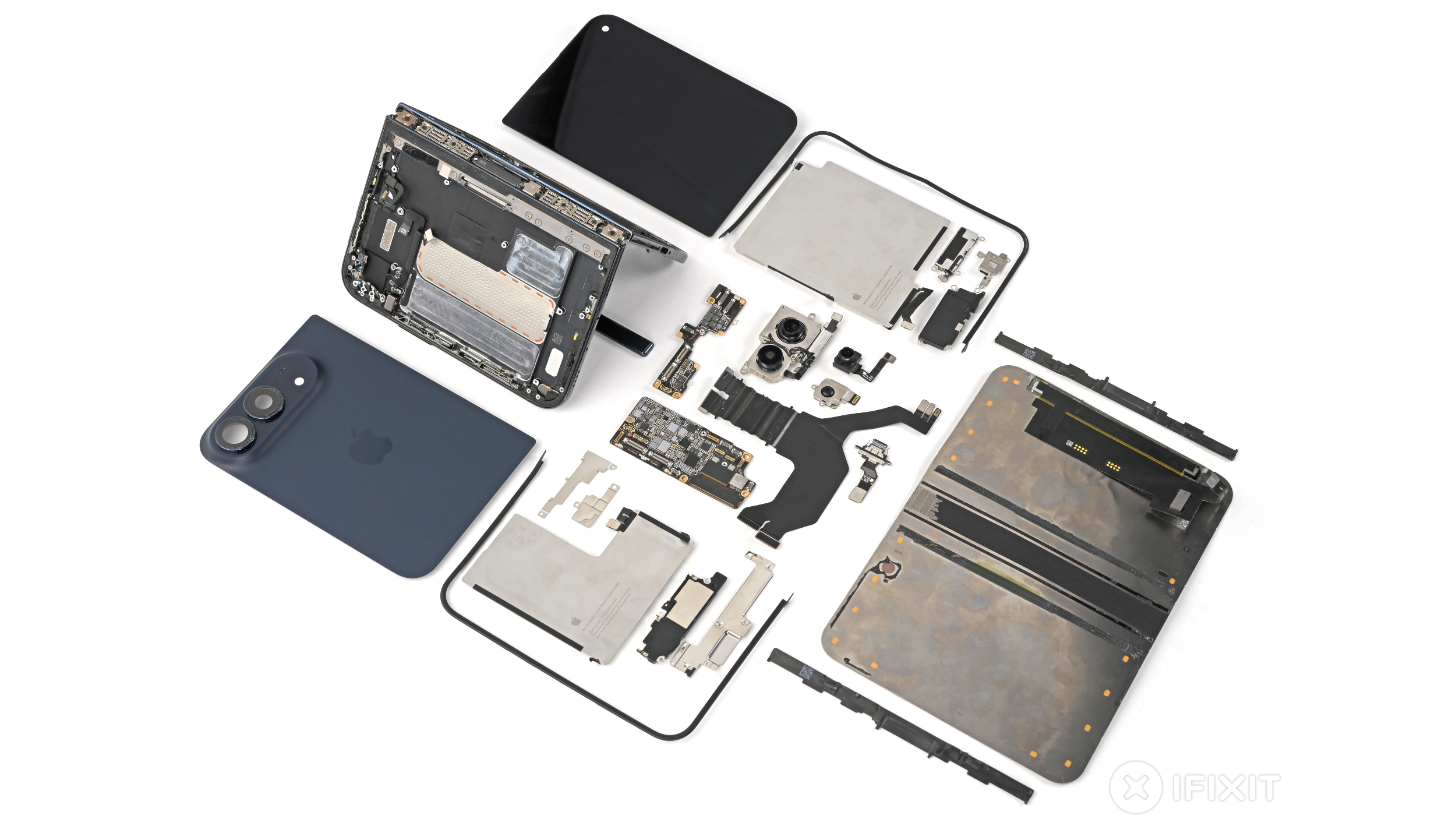
Teardown site iFixit took apart the iPhone Duo to see what’s inside, how it holds up to dust, and how repairable it is. There’s a video walking through the teardown, as well as a blog post summing it up. Before opening up the Duo, iFixit inundated it with fluorescent dust.
The ‌iPhone Duo‌ has an IP68 dust and water resistance rating, which means it’s sealed against dust. IFixit found dust in the USB-C port, speaker mesh, and bezel, but few particles reached the internals of the device. Particles did infiltrate the hinge, causing it to crunch, and that could lead to screen damage.
The ‌iPhone Duo‌’s hinge gathered less dust than the Galaxy Z Fold8 or the Pixel 11 Pro Fold during similar tests. IFixit said the result is "encouraging," but suggested it’s not a great device for the beach because some dust still got to moving parts. YouTuber JerryRigEverything also did a dust test where particles entered the hinge and caused the magnets that hold the phone shut to fail.
IFixit’s teardown of the iPhone Duo is up, revealing some interesting (and some worrisome) details about what it calls the most repairable foldable phone yet. Here are the details.
IFixit tears down iPhone Duo, finds possible causes of early screen failures. IPhone Duo launch day: Lines form at Apple Stores, walk-in availability limited Chance Miller Oct 23 2026.
IFixit was able to peel the cover layer away easily, which is as Apple intended. Apple made the nano-texture cover layer simple to remove so it could be replaced inexpensively, but you’re not supposed to take it off on your own.
With AppleCare +, replacing the cover layer is $19, and it’s $49 without it. The ‌iPhone Duo‌ uses the battery adhesive Apple introduced with the iPhone 16, so a small electrical charge loosens the adhesive and allows the batteries to be removed.
IFixit said it was the "best battery removal experience" from a foldable to date. The outer display was easy to take off, and iFixit said the construction is "solid," which is a plus for repairability since most internal repairs have to go through the outer display.
The inner screen trim comes off with heat, but there is a lot of adhesive to get through to remove the inner panel. Apple describes the ‌iPhone Duo‌’s inner display as a 10-layer stack, and iFixit was able to peel back some of the layers to get a look at them under the microscope.
The ‌iPhone Duo‌ uses an unstacked logic board, and it’s the first iPhone to do so since the iPhone 8. The single-layer design is one way Apple kept the Duo thin.
IFixit commented on some of the display failures people have been seeing, suggesting they could be caused by pressure, a trapped particle, repeated bending, or a manufacturing defect. It may not be that the display has physically snapped, because a wiring problem can cause the same effect.
Where most of the faulty units are experiencing issues, the hinge has a different shape. The failure spot is also near where the accordion cable passes by and where several edges meet, which could be leading to a concentration of stress in that spot.
From iFixit: To see where the stresses build up from folding, we built a 3D hinge model from teardown footage, patents, and CT scans, then compared it with the reported damage locations. The breaks cluster near the transition from the gap for the crossing flex cable to the central hinge support.
The damage we’re seeing in photos isn’t right where the display cable passes through the hinge, but slightly lower, at a point where several edges meet and change how the thin display is supported as it bends. IFixit said it could also be the curved rails of the hinge that follow the screen’s pivot points.
Discover more from ChuckysCarnage
Subscribe to get the latest posts sent to your email.

