
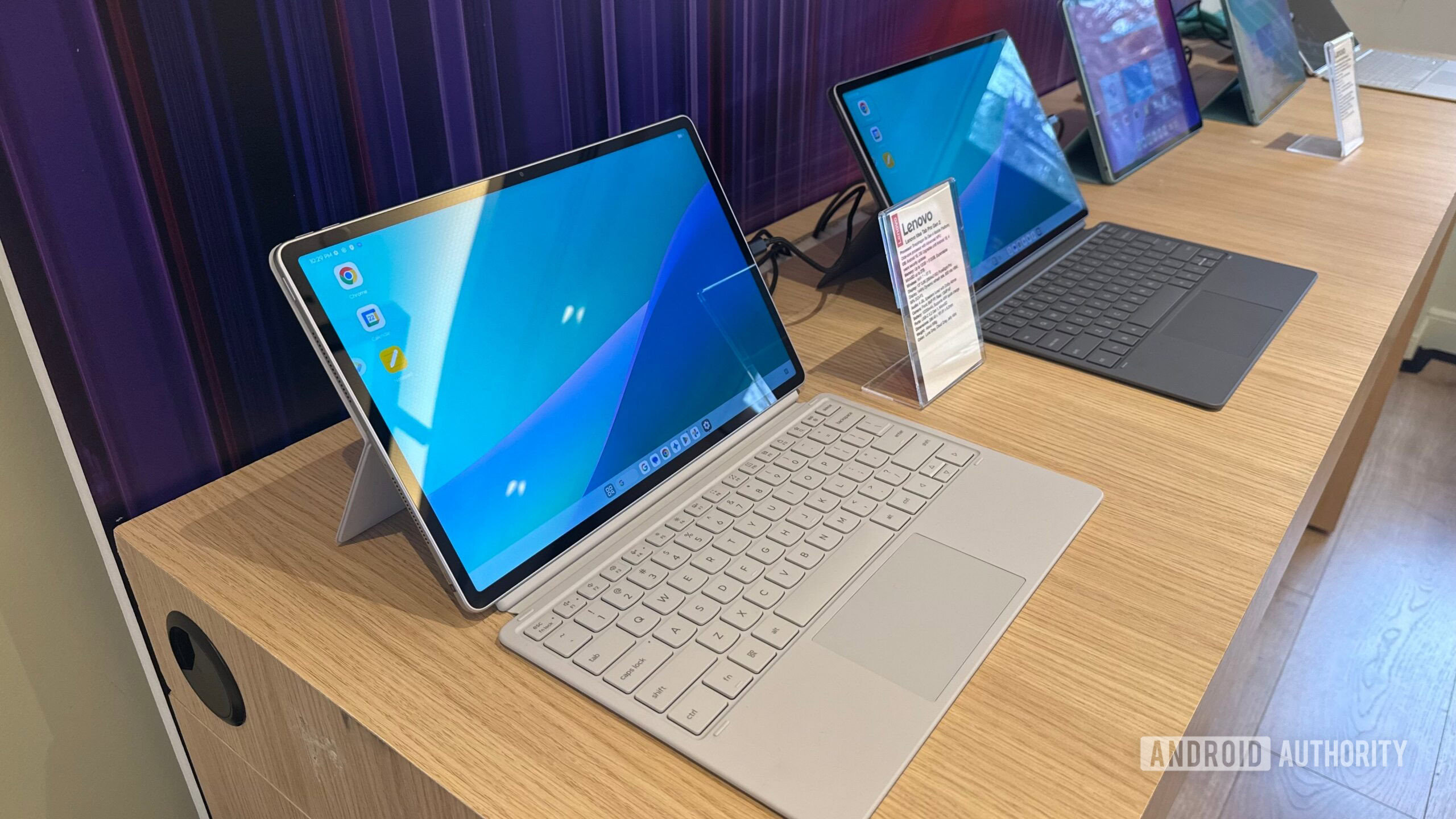
Lenovo Idea Tab Pro Gen 2 drops to $447.36 on Amazon, with a 13-inch 3.5K 144Hz display, pen, and folio case included. Save $102 on Lenovo’s big-screen Idea Tab Pro Gen 2 tablet. This model stands out with a 13-inch 3.5K IPS touchscreen and a fast 144Hz refresh rate, giving you a large, sharp display that’s well suited for both entertainment and day-to-day tasks.
Inside, the tablet packs a Qualcomm Snapdragon 8s Gen 4 chip with Adreno 825 graphics, plus 8GB of RAM and 128GB of storage. That setup gives it upper-midrange to near-premium performance, which is a good fit for streaming, note-taking, and light creative work. The screen is one of the main highlights here, with a 3504 x 2190 resolution, strong color coverage, and brightness that works well for both watching content and staying productive.
It also comes bundled with the Lenovo Tab Pen Plus and a folio case, making it ready for handwriting, sketching, school, or office use right out of the box. Lenovo also positions the tablet as a strong value option for buyers who want a large-screen experience without paying the much higher prices often associated with top-end flagship tablets.
Apple’s new MacBook Pro with PROLED XDR Display features tandem OLED technology, touchscreen input, the Dynamic Island, and a thinner, lighter design. It joins the existing Liquid Retina XDR models introduced in March 2026, with both versions offering the same M5 Pro and M5 Max chips.
The PROLED models carry a $400 starting-price premium across equivalent sizes and chip tiers. The 14-inch M5 Pro starts at $2,499 with Liquid Retina XDR or $2,899 with PROLED XDR, while the corresponding 16-inch models start at $2,999 and $3,399.
With chip options, memory capacities, and battery life unchanged, the decision largely centers on how much you value the new display, touch interaction, and slightly improved portability. Here are all of the differences between the Liquid Retina XDR and PROLED XDR MacBook Pro models: Display Liquid Retina XDR ‌MacBook Pro‌ PROLED XDR ‌MacBook Pro‌ Mini-LED-backlit LCD with local dimming Tandem ‌OLED‌ with two self-illuminating pixel layers Zone-based backlighting Individual pixel illumination Dedicated display engine, compensating for content, temperature, environment, and individual pixel usage over time 1,000,000:1 contrast ratio 10,000,000:1 contrast ratio Up to 1,600 nits peak HDR brightness Up to 2,000 nits peak HDR brightness Up to 1,000 nits outdoor SDR brightness Up to 1,000 nits sustained full-screen SDR brightness and 2,000 nits peak outdoor SDR brightness P3 wide color gamut P3 and Adobe RGB wide color gamuts 14-inch: 14.2-inch display, 3024 × 1964 resolution 14-inch: 14.2-inch display, 3024 × 1986 resolution 16-inch: 16.2-inch display, 3456 × 2234 resolution 16-inch: 16.3-inch display, 3472 × 2266 resolution Wider display borders and camera notch Slimmer display borders and smaller camera cutout with ‌Dynamic Island‌ Rounded top display corners and square bottom corners Rounded display corners at all four corners Standard display or optional nano-texture display Antireflective coating, fingerprint-resistant oleophobic coating, and optional nano-texture cover glass Multi-Touch sensor integrated directly into the display panel, rather than layered on top, to reduce latency and bulk Both versions deliver up to 1,000 nits of sustained full-screen HDR brightness, so PROLED’s 2,000-nit peak does not necessarily mean the display is twice as bright across every task.
Both retain a 1-nit minimum brightness, True Tone, support for one billion colors, and a 254-pixel-per-inch density. Design and Dimensions The weight reduction is more substantial than the change in thickness with the latest models.
The measurements below cover both chip tiers in each size: Liquid Retina XDR PROLED XDR Reduction 14-inch height 1.55 cm 1.50 cm 3.2% 14-inch width 31.26 cm 31.08 cm 0.6% 14-inch depth 22.12 cm 21.63 cm 2.2% 14-inch M5 Pro weight 1.60 kg 1.38 kg 13.8% 14-inch M5 Max weight 1.62 kg 1.40 kg 13.6% 16-inch height 1.68 cm 1.60 cm 4.8% 16-inch width 35.57 cm 35.55 cm 0.1% 16-inch depth 24.81 cm 24.42 cm 1.6% 16-inch M5 Pro weight 2.14 kg 1.82 kg 15.0% 16-inch M5 Max weight 2.15 kg 1.84 kg 14.4% The redesign also changes the hinge, cooling system, and rear Apple logo: Liquid Retina XDR ‌MacBook Pro‌ PROLED XDR ‌MacBook Pro‌ Previous standard hinge design Redesigned hinge for greater stability during touchscreen use Previous standard thermal architecture Redesigned thermal architecture redirects warm air away from the display; Apple says sustained M5 Pro and M5 Max performance is maintained Non-illuminated rear Apple logo Illuminated rear Apple logo Audio and Camera The upgraded audio system brings improvements for both portable and desktop use: Liquid Retina XDR ‌MacBook Pro‌ PROLED XDR ‌MacBook Pro‌ Previous force-cancelling woofer design Redesigned woofers deliver 50% deeper bass Previous tweeter design Redesigned tweeters shape sound dispersion to improve clarity Dedicated audio tuning for closed-lid use with an external display 12MP Center Stage camera with computational video 12MP Center Stage camera with computational video and advanced video stabilization to reduce camera-feed shake during touchscreen use Camera resolution, Center Stage, Desk View, and 1080p recording remain unchanged, as do the six-speaker count, Spatial Audio support, and three-microphone array. Storage, External Displays, and Power Liquid Retina XDR ‌MacBook Pro‌ PROLED XDR ‌MacBook Pro‌ M5 Max storage: 2TB, 4TB, or 8TB M5 Max storage: 2TB, 4TB, 8TB, or 16TB M5 Pro: three external 4K displays at up to 144Hz M5 Pro: three external 4K displays at up to 165Hz M5 Max: four external 4K displays at up to 144Hz M5 Max: four external 4K displays at up to 165Hz Genlock synchronizes display refresh with camera capture 14-inch battery capacity: 72.4Wh 14-inch battery capacity: 72.6Wh 16-inch M5 Max: 70W minimum recommended charging 16-inch M5 Max: 94W minimum recommended charging M5 Pro storage remains limited to 1TB, 2TB, or 4TB.
The external-display refresh-rate increases apply to the specific arrangements listed above, rather than every resolution and monitor combination. It is also worth noting that the slightly larger 14-inch battery seemingly does not increase endurance.
Touch and Dynamic Island Liquid Retina XDR ‌MacBook Pro‌ PROLED XDR ‌MacBook Pro‌ Keyboard, trackpad, and pointer input Keyboard, trackpad, pointer, and direct onscreen Multi-Touch input Scrolling, zooming, and dragging through the trackpad or other input devices Additional direct onscreen swiping, pinch-to-zoom, and drag-and-drop gestures Window controls operated through the keyboard, trackpad, or pointer Additional touch gestures, including double-tapping a window to fill the screen and flicking to tile it macOS translates onscreen touches into clicks for existing applications Touch-specific interactions through updated gesture APIs Camera "notch" Dynamic Island for Live Activities and controls, including music playback, phone calls, AirDrop requests, and more Spotlight Spotlight moves into ‌Dynamic Island‌ when Siri AI is available and enabled Accessibility controls Additional listed AssistiveTouch and Touch Accommodations features Environmental Differences Liquid Retina XDR ‌MacBook Pro‌ PROLED XDR ‌MacBook Pro‌ 45% recycled content 55% recycled content 50% renewable manufacturing electricity 45% renewable manufacturing electricity 100% recycled tantalum in multiple capacitors, a first for Apple Pricing and Availability Current U.S. Starting prices put PROLED $400 above each corresponding Liquid Retina XDR model: Liquid Retina XDR PROLED XDR 14-inch M5 Pro $2,499 $2,899 16-inch M5 Pro $2,999 $3,399 14-inch M5 Max $4,099 $4,499 16-inch M5 Max $4,399 $4,799 Launch date March 11, 2026 November 6, 2026 The Liquid Retina XDR models remain in Apple’s lineup.
Their current prices reflect increases since their March introduction, so comparing original launch prices exaggerates the present starting-price premium for PROLED. Is It Worth Upgrading.
For most existing M5 Pro and M5 Max ‌MacBook Pro‌ owners, there is little reason to upgrade. Both versions use the same chips, so equivalent configurations should deliver essentially the same processing performance.
Neither the maximum memory capacity nor battery life has increased. The strongest exceptions are professionals who need the ‌OLED‌ display’s advanced capabilities, genlock, or more than 8TB of internal storage.
Adobe RGB coverage and additional reference modes may address specific requirements for photographers, designers, and other professionals, while the 16TB option accommodates projects that exceed the older model’s storage ceiling. These are essentially reasons to upgrade for a particular workflow, rather than for better everyday performance.
Discover more from ChuckysCarnage
Subscribe to get the latest posts sent to your email.

