
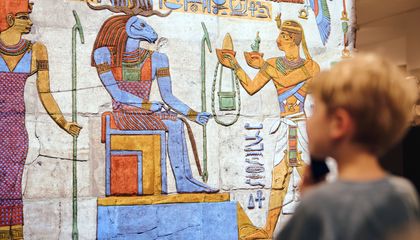
Digital projections at Oxford’s Ashmolean Museum will restore the sight of Egyptian blue, the world’s oldest synthetic pigment, and other colors that once adorned the 2,700-year-old Shrine of Taharqa. Faded Over Millennia, the Intricately Carved Sandstone Walls of This Ancient Egyptian Shrine Will See Color Once Again. Researchers discovered traces of Egyptian Blue, the world’s oldest-known synthetic pigment, which was typically used to color deities and royals.
Fisher Studios, courtesy Ashmolean Museum, University of Oxford Roughly 2,700 years ago, in the deserts of present-day northern Sudan, a massive shrine was brought to rise in the city of Kawa. Built from 236 sandstone blocks inside a temple to Amun-Ra, the king of the ancient Egyptian gods, the shrine’s ornate sandstone walls told an unmistakable story of devotion and power. Known as the Shrine of Taharqa after the pharaoh who commissioned it, the structure’s carvings show several depictions of Taharqa—the ruler of both Egypt and Kush between 690 B.C.E.
And 664 B.C.E.—extending offerings to gods while exerting royal influence among his mortal subjects. Modern research suggests that during Taharqa’s time, these scenes were plastered and painted in vibrant color. But by the 1930s, when the shrine was excavated by British archaeologists, the carved sandstone was remarkably intact but colorless.
Later transferred to the Ashmolean Museum in Oxford, England, modern eyes have only ever looked upon the shrine—the only free-standing pharaonic building in Britain—as a beige sandstone relic.
Discover more from ChuckysCarnage
Subscribe to get the latest posts sent to your email.

