
Soft tissues like blood generally break down relatively quickly after death. Environmental factors can also produce red blood cell look-alikes, so many outside researchers are cautious about the new study’s claims. Scientists Say They’ve Found Preserved Dinosaur Blood in a 115-Million-Year-Old Fossil, but Not Everyone Is Convinced.
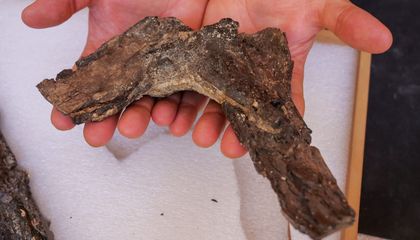
The fossil was discovered in a mine in northeastern Brazil in 2008. Curtin University Scientists say they’ve discovered blood inside a 115-million-year-old dinosaur bone. That’s backed by their detection of heme, an iron-rich molecule in hemoglobin, the protein in red blood cells that carries oxygen and gives blood its red color.
The findings, described November 2 in the Proceedings of the National Academy of Sciences, potentially represent the oldest red blood cells ever found in a dinosaur fossil. “Evidence from microscopy, mineralogy, spectroscopy and molecular geochemistry all point toward the same conclusion,” lead author Kliti Grice, a geochemist at Curtin University in Australia, writes for the Conversation. “We are convinced these are fossilized red blood cell structures containing traces of heme molecules.” However, some outside experts remain unconvinced.
Grice and colleagues made their discoveries while analyzing a hind leg bone of an Aratasaurus museunacionali, a small, bipedal, meat-eating dinosaur that lived during the Cretaceous period. This individual is believed to have been about 4 years old when it died; it wasn’t yet fully grown, weighing an estimated 75 pounds and measuring about 10 feet long.
Discover more from ChuckysCarnage
Subscribe to get the latest posts sent to your email.

