
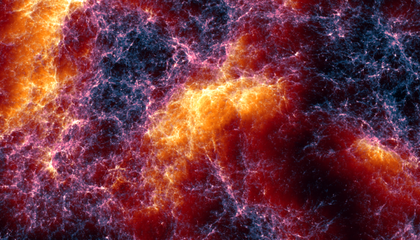
The model, created by researchers at the Center for Astrophysics, Harvard & Smithsonian, and other institutions, captures how the first stars and black holes gradually illuminated the universe after millions of years of darkness. See a Stunning Simulation of the Early Universe, Which Will Help Astronomers Shed Light on the Cosmic Dark Ages. Simulation of gas structures as electrons were removed from helium by radiation emitted by early stars and black holes.
Oliver Zier / Center for Astrophysics | Harvard & Smithsonian At first, there was nothing; then, there was light. The universe was born in a rapid explosion of energy known as the Big Bang some 13.8 billion years ago. For the first 380,000 years, the universe was hot, dense soup: a relatively simple mix of negatively charged electrons and nuclei of the elements hydrogen and helium.
The universe cooled, allowing the electrons to join the hydrogen and helium, which coalesced into a neutral cloud of gas. Without an abundance of free electrons to scatter leftover energy from the Big Bang—and no stars or galaxies to give off light—the universe plunged into a period called the cosmic dark ages. While scientists have a good understanding of the Big Bang and its immediate aftermath, this second phase is less clear.
“The dark ages is this transition from simple physics into this overwhelmingly complex physics,” explains Volker Bromm, an astronomer at the University of Texas at Austin.
Discover more from ChuckysCarnage
Subscribe to get the latest posts sent to your email.

