
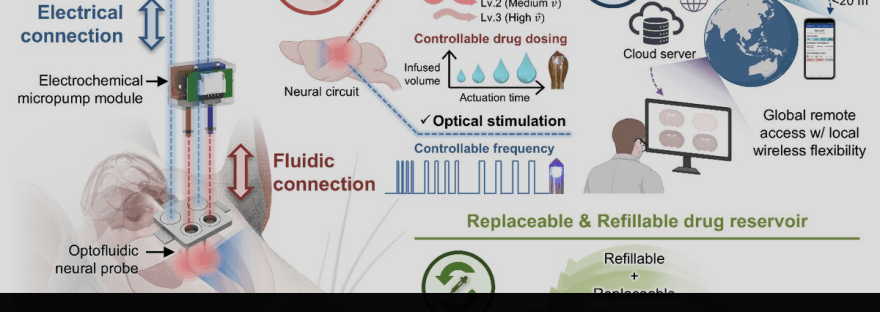
A researcher in Chicago remotely controls a miniaturized brain implant in Daejeon, Korea—over the internet. Korean researchers have developed a wireless device that can deliver drugs and light to precisely modulate targeted neurons from anywhere in the world. The technology should overcome the constraints of distance and location, supporting long-term studies of brain disorders and the future development of therapeutic devices.
Neural implant in Korea remotely controlled from the United States. Neural implant in Korea remotely controlled from the United States by The Korea Advanced Institute of Science and Technology (KAIST) edited by Sadie Harley, reviewed by Robert Egan Sadie Harley Scientific Editor Meet our editorial team Behind our editorial process Robert Egan Senior Editor Meet our editorial team Behind our editorial process Editors' notes This article has been reviewed according to Science X's editorial process and policies. Editors have highlighted the following attributes while ensuring the content's credibility: fact-checked peer-reviewed publication trusted source proofread The GIST Add as preferred source Conceptual diagram of the IoT-based wireless neural implant.
(Left) Device configuration integrating the wireless circuit module, electrochemical micropump module, and optofluidic neural probe via magnetic coupling, together with the electrical and fluidic connection structure. (Right) Programmable drug infusion and optical stimulation with multilevel flow-rate and frequency control. A research team led by Professor Jae-Woong Jeong from the KAIST School of Electrical Engineering, in collaboration with Professor Wha Young Kim's team at Yonsei University College of Medicine, has developed an IoT-enabled wireless neural implant that integrates drug delivery, optical stimulation, wireless communication and internet-based remote control into a single miniaturized device.
Discover more from ChuckysCarnage
Subscribe to get the latest posts sent to your email.

