
Shine a light, and the real can be distinguished from the fake. KAIST researchers have developed a security technology that uses unique artificial fingerprints created by the random assembly of nanoparticles. Although extremely difficult to replicate, these fingerprints can be conveniently authenticated using only a smartphone flashlight and a laser pointer, opening up potential applications in anti-counterfeiting and electronic device authentication.
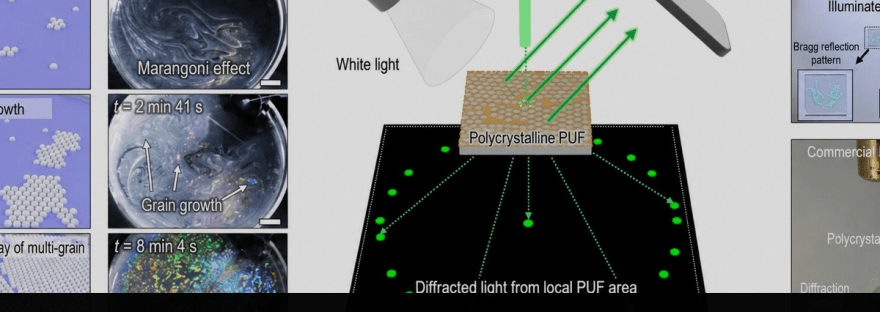
Using light to distinguish real from fake with hard-to-replicate 'artificial fingerprints'. August 26, 2026 Using light to distinguish real from fake with hard-to-replicate 'artificial fingerprints' by The Korea Advanced Institute of Science and Technology (KAIST) edited by Sadie Harley, reviewed by Robert Egan Sadie Harley Scientific Editor Meet our editorial team Behind our editorial process Robert Egan Senior Editor Meet our editorial team Behind our editorial process Editors' notes This article has been reviewed according to Science X's editorial process and policies. Editors have highlighted the following attributes while ensuring the content's credibility: fact-checked peer-reviewed publication trusted source proofread The GIST Add as preferred source Schematic illustration of polycrystalline colloidal self-assembly and the PUF authentication method.
A research team led by Professor Sang Ouk Kim from the Department of Materials Science and Engineering, in collaboration with a team led by Professor Seok Joon Kwon of Sungkyunkwan University, has developed a new foundational security technology based on randomly assembled colloidal nanopatterns—unique microscopic patterns formed by particles too small to be seen with the naked eye. The technology enables authentication using everyday light sources such as smartphone flashlights and laser pointers. The work is published in the journal Nature Communications.
Discover more from ChuckysCarnage
Subscribe to get the latest posts sent to your email.

