
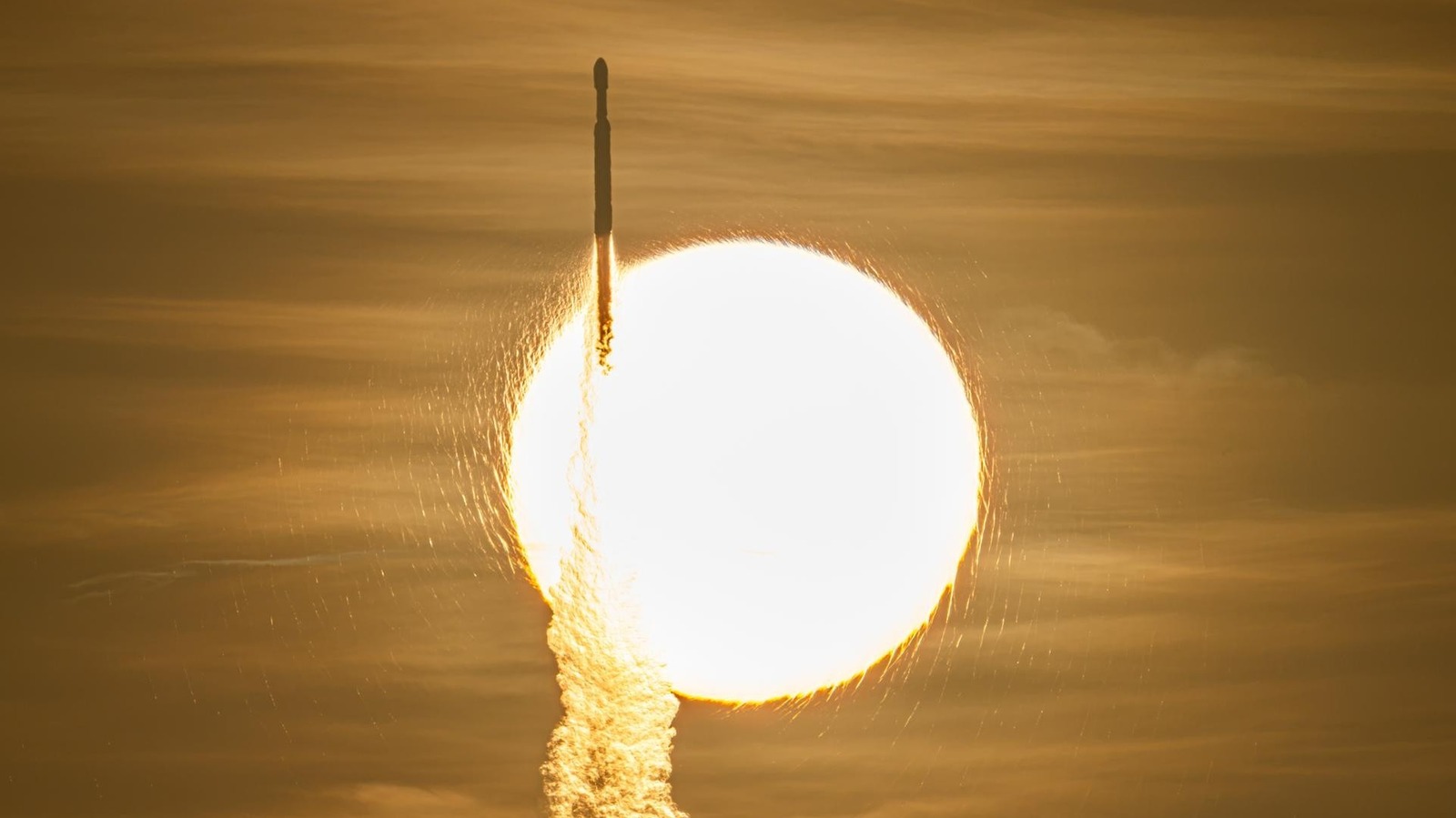
Now on a three-month, million-mile journey to its final orbit, NASA’s Nancy Grace Roman Space Telescope will soon reveal the universe’s darkest secrets. The mission launched at 7:26 a.m. EDT Sunday aboard a SpaceX Falcon Heavy rocket from Launch Complex 39A at the agency’s Kennedy Space Center in Florida.
Roman pairs a large field of […]. NASA’s Dark Universe-Seeking Nancy Grace Roman Space Telescope Launches. Dooren Aug 30, 2026 RELEASE 26-071 NASA Headquarters A SpaceX Falcon Heavy rocket with NASA’s Nancy Grace Roman Telescope on board is seen transiting the sun during launch from Launch Complex 39A, Sunday, Aug.
30, 2026, at NASA’s Kennedy Space Center in Florida. Roman pairs a large field of view with crisp infrared vision to explore vast swaths of the sky and probe deeply into cosmic history. This flagship mission will help astronomers explore dark matter, dark energy, and worlds outside of our solar system, known as exoplanets.
Its first images should arrive in early 2027. NASA’s Nancy Grace Roman Space Telescope is now on its way to study the ‘dark universe’.
NASA’s new space telescope, which is able to image swaths of the sky 100 times larger than what Hubble could capture, launched this morning from NASA’s Kennedy Space Center on a SpaceX Falcon Heavy rocket. The space agency confirmed shortly after launch that Roman had successfully deployed its solar panels and lower instrument sun shade.
Over the coming days and weeks, the rest of its instruments will deploy and activate. Once it’s all up and running, NASA says Roman will send home 1.4 terabytes of data a day.
"Roman will be a discovery machine that will bring us closer than ever before to answering humanity’s most profound questions about our cosmic history," said Nicky Fox, associate administrator for NASA’s Science Mission Directorate. "With its large field of view and fast survey speeds, Roman will usher us into a new era of discovery and make the invisible visible, setting the foundation for humanity’s search for life beyond our solar system." In addition to helping scientists investigate dark matter and dark energy, the Nancy Grace Roman Space Telescope will observe exoplanets and planet-forming discs.
Its surveys will support a broad range of research extending far beyond the mission’s main science goals. “Roman is exactly the kind of success story we want to see across NASA,” said NASA Administrator Jared Isaacman.
Discover more from ChuckysCarnage
Subscribe to get the latest posts sent to your email.

