
In a new Nature Communications study, researchers developed a universal scaling framework for the strength of granular asteroids, showing that their tensile strength can be predicted from the size and shape of their constituent particles. Particle shape and size predict asteroid strength, revealing Bennu's surface is 50 times weaker than ground coffee. September 4, 2026 feature Particle shape and size predict asteroid strength, revealing Bennu's surface is 50 times weaker than ground coffee by Tejasri Gururaj, Phys.org Tejasri Gururaj Author Meet our staff & contributors Learn about our editorial standards edited by Sadie Harley, reviewed by Robert Egan Sadie Harley Scientific Editor Meet our editorial team Behind our editorial process Robert Egan Senior Editor Meet our editorial team Behind our editorial process Editors' notes This article has been reviewed according to Science X's editorial process and policies.
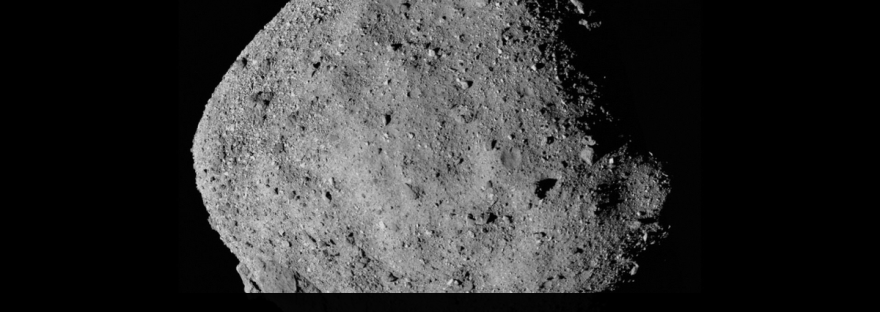
Editors have highlighted the following attributes while ensuring the content's credibility: fact-checked peer-reviewed publication trusted source proofread The GIST Add as preferred source A mosaic image of Bennu composed of pictures taken by the OSIRIS-REx spacecraft. https://www.nasa.gov/news-release/nasas-newly-arrived-osiris-rex-spacecraft-already-discovers-water-on-asteroid/. Space missions have revealed that many small asteroids, such as Bennu, Ryugu and Itokawa, are not solid rocks but granular asteroids: loosely bound collections of dust, rock and boulders held together by their own gravity and weak cohesive forces.
Researchers have studied how these bodies are held together for more than a decade. Previous simulations could only treat their fine grains as perfect spheres, while real grains are angular and irregular. The current study found a way to incorporate realistic particle shapes into the simulations.
Phys.org spoke to first author Paul Sánchez, a senior research associate at the University of Colorado Boulder. "The original idea was suggested by Dr. Swift (University of Nottingham, U.K.), who was my Ph.D.
Supervisor and came to Boulder for a visit," said Sánchez. "We needed to find the effect that small cohesive particles could have in an asteroid, but simulating all the particles that are needed was (and still is) impossible.
So the suggestion was to take some inspiration from the liquid bridges that water on Earth forms between tiny grains of sand." Simulation setup. A Mechanically stable granular bridge for α 1 = α 2 = 1 and d ∈ [4, 5] cm.
B The granular bridges as a function of particle size. C A zoomed-in view illustrating the progressive failure of the granular bridge for α 1 = α 2 = 1 and d ∈ [4, 5] cm, from the initial state to complete rupture.
D The variety of polyhedral shapes used in the study, characterized by different aspect ratios. DOI: 10.1038/s41467-026-75169-4 Rubble-pile spin barrier "It has been observed that small asteroids [less than 150 meters (490 feet) across] can rotate with spin periods below 2.4 hours, whereas for larger asteroids this is a barrier ('rubble-pile spin barrier').
This barrier is a basic result of the self-gravity of the asteroids," said Sánchez. A rubble pile spinning fast enough will fling itself apart, and for a body held together by gravity alone, that limit does not depend on size.
Larger asteroids respect it, which is itself evidence that they are rubble piles rather than solid rock. Smaller asteroids do not.
Self-gravity weakens rapidly as a body shrinks, while cohesive forces between grains do not. Below that size, cohesion can become the dominant force holding an asteroid together.
Cohesion does not replace gravity, however—it adds to it. In 2010, Sánchez and his colleagues proposed that van der Waals forces between fine grains could supply that strength.
These grains make up an asteroid's regolith, the loose dust and rock covering its surface. The team tested the idea in 2014 with spherical particles, and the results suggested small grains could act as a weak cement between larger boulders.
Two things were still missing.
Discover more from ChuckysCarnage
Subscribe to get the latest posts sent to your email.

