The COSMOS field, or Cosmic Evolution Survey Deep Field, is one of the most famous patches of the universe observed by astronomers. Located in the constellation Sextans, this region was photographed by the Hubble Space Telescope (HST) in segments from 2003 to 2005 using its Advanced Camera for Surveys (ACS). With support from ground-based and other space-based telescopes, the resulting images were then stitched together to create a stunning picture of cosmic evolution.
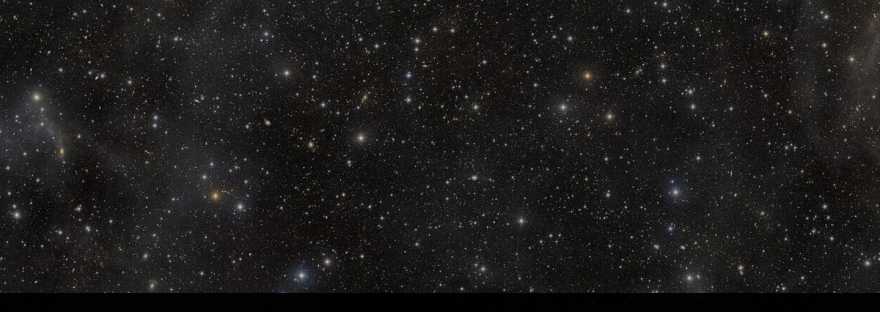
September 12, 2026 Rubin observatory peers deep into the famous COSMOS field by Matthew Williams, Universe Today edited by Sadie Harley, reviewed by Andrew Zinin Sadie Harley Scientific Editor Meet our editorial team Behind our editorial process Andrew Zinin Chief Editor Meet our editorial team Behind our editorial process Editors' notes This article has been reviewed according to Science X's editorial process and policies. Editors have highlighted the following attributes while ensuring the content's credibility: fact-checked trusted source proofread The GIST Add as preferred source This exceptionally deep image from NSF–DOE Vera C. Rubin Observatory reveals the renowned COSMOS field and its surroundings in the constellation Sextans.
Rubin Observatory/NOIRLab/SLAC/AURA The COSMOS field, or Cosmic Evolution Survey Deep Field, is one of the most famous patches of the universe observed by astronomers. Rubin Observatory looked in and around this field not long ago and captured the most detailed view to date of the hundreds of thousands of galaxies, stars and celestial environments therein. This marks the first time the observatory's Legacy Survey of Space and Time (LSST) Camera —the most powerful digital camera in the world—produced an image and catalog for scientific research.
Rubin's sensitivity and high resolution are already giving astronomers a powerful new view of this famous cosmic landmark. Astronomers have studied the COSMOS field for more than two decades, directing many of the world's leading telescopes to observe it in different wavelengths (optical, radio, ultraviolet, X-rays, etc.). Because it is so well studied, it has served as a reference point for testing new instruments, comparing measurements and combining observations.
Now, Rubin has visualized it using its combination of depth, wide-field coverage and ability to make repeated observations. "The COSMOS field is a very important one for LSST science," said Phil Marshall, the deputy director of Rubin Observatory at the SLAC National Accelerator Laboratory.
"Its wealth of prior observations, and its repeated targeting both during commissioning and as one of LSST's deep fields, will make it very valuable as a testing ground for scientists as they get ready to take on the survey data." Zoom on Rubin Observatory’s Image of the COSMOS Field. The image was released to coincide with Rubin's Early Data Preview 2 (EDP2), the first phase of Rubin's Data Preview 2 release that combines Rubin's observations obtained between April 2025 and January 2026 as part of its science validation period.
Bob Blum, director of Rubin Observatory at NSF NOIRLab, said: The COSMOS deep image is just the beginning for Rubin in this region. Repeated visits to the field over the next few years will demonstrate the power of our survey design for discovery by providing our science community with a huge number of transient and variable objects like supernovae and other explosive transients for follow-up and detailed study.
The new image was created by stacking hundreds of individual observations made by the 3.2-gigapixel LSST Camera and contains more than half a million galaxies and more than 50,000 individual stars. It also features many types of galaxies, including barred spirals with arms, smooth ellipticals, faint red galaxies and distorted merging galaxies.
The stars in the image are those located in the Milky Way and lie along the line of sight. These are a minute fraction of the stars the LSST Camera avoids by looking away from the crowded plane of the Milky Way.
This kept the image from being obscured by the galactic disk and the clouds of dust and gas in the interstellar medium (ISM). This allows observatories to obtain sharper views of the cosmos, seeing farther into space and farther back in time.
As a result, astronomers can study galaxies and the structure of the universe during different periods of its evolution. Pan on Rubin Observatory’s Image of the COSMOS Field.
To providing an in-depth view of the many objects in the COSMOS field over time, it gives scientists the opportunity to test and validate Rubin's tools and data products and prepare for the long-term survey ahead. As Blum added: Key concepts Galaxies Superbubbles Time domain astronomy Catalogs Microbiology lab background with pharmaceutical news experience in oil, gas, and renewable industries.
Full profile → Andrew Zinin Master's in physics with research experience. Long-time science news enthusiast.
Plays key role in Science X's editorial success.
Discover more from ChuckysCarnage
Subscribe to get the latest posts sent to your email.

