
We've found more than 5,500 exoplanets so far. Dozens of them are in the habitable zones of their parent stars, where, at least in theory, they could host an ocean. But we've never definitively found a liquid ocean on another planet.
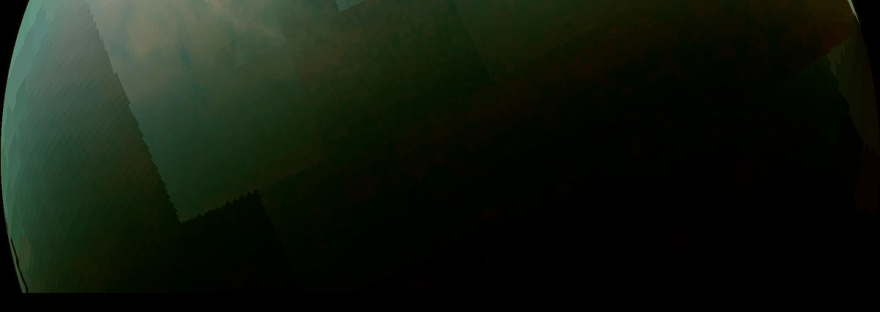
September 13, 2026 NASA's next great observatory could spot oceans on distant worlds by Andy Tomaswick, Universe Today edited by Swati Mestri, reviewed by Andrew Zinin Swati Mestri Scientific Editor Meet our editorial team Behind our editorial process Andrew Zinin Chief Editor Meet our editorial team Behind our editorial process Editors' notes This article has been reviewed according to Science X's editorial process and policies. Editors have highlighted the following attributes while ensuring the content's credibility: fact-checked peer-reviewed publication trusted source proofread The GIST Add as preferred source Image of the specular reflection (i.e. Glint) off of Titan, captured by Cassini.
A new paper from researchers Eleanor Cornish and Tyler Robinson, of the University of Arizona, available as a preprint on arXiv and submitted to The Astrophysical Journal, looks at a unique way we might be able to find one—by looking for its "glint." Glint is the common term for what physicists call specular reflection. On Earth, it's a common sight at beaches when sunlight hits the water at a low angle and the horizon lights up with a brilliant flash of gold. But that same feature can happen on other surfaces—famously, gold has a "glint" when seen from the right angle.
But most of what makes up exoplanets, like sand, rock and soil, doesn't glint. They are what physicists call Lambertian surfaces—they bounce light in all directions equally. Fraser discusses the possibility of "Hycean" worlds that are completely covered in oceans.
It acts sort of like a mirror. When seen from straight above, light mostly penetrates straight down or reflects weakly.
But when it bounces off water at a shallow angle, it reflects, and physicists understand how it does. In the case of an exoplanet, this shallow angle occurs during its crescent phase, when we're looking at mostly the nightside of a planet with only a sliver actually illuminated.
When a planet is at this angle, incoming starlight would bounce straight off an ocean and directly into a telescope, causing the planet to brighten dramatically from the telescope's perspective. This phenomenon isn't theoretical.
In 2009, Cassini detected a specular glint off the hydrocarbon lakes on the surface of Titan. Decades before that, a team of researchers including Carl Sagan used a Galileo flyby of Earth to spot glint reflecting off our own oceans.
In other words, we know we can do it, but so far we haven't done so for exoplanets. That might be about to change.
The researchers turned to an atmospheric tool and modified it for the purpose of detecting glint. Using the tool, known as rfast, they incorporated a model known as the Cox–Munk ocean model to reflect how wind speeds and wave ripples would affect the light reflected back to a telescope.
Fraser talks about the technology behind coronagraphs – the technique used to suppress starlight from host stars. At that angle, another phenomenon called glint reddening kicks in.
At these high angles, starlight that skims off the surface of an ocean has to travel much longer through the planet's atmosphere. While doing so, it is subjected to Rayleigh scattering, the atmospheric effect that scatters blue light and famously makes our sky blue.
By the time the light has reached a telescope, most of the blue wavelengths have been stripped away, leaving primarily a red coloration. This is all good news for telescope designers, especially those working on the Habitable Worlds Observatory (HWO).
Theoretical papers originally thought ocean glint might only be observable at 130°, and a higher phase angle means the planet must be closer to its parent star when it is observed.
Discover more from ChuckysCarnage
Subscribe to get the latest posts sent to your email.
 ChuckysCarnage