
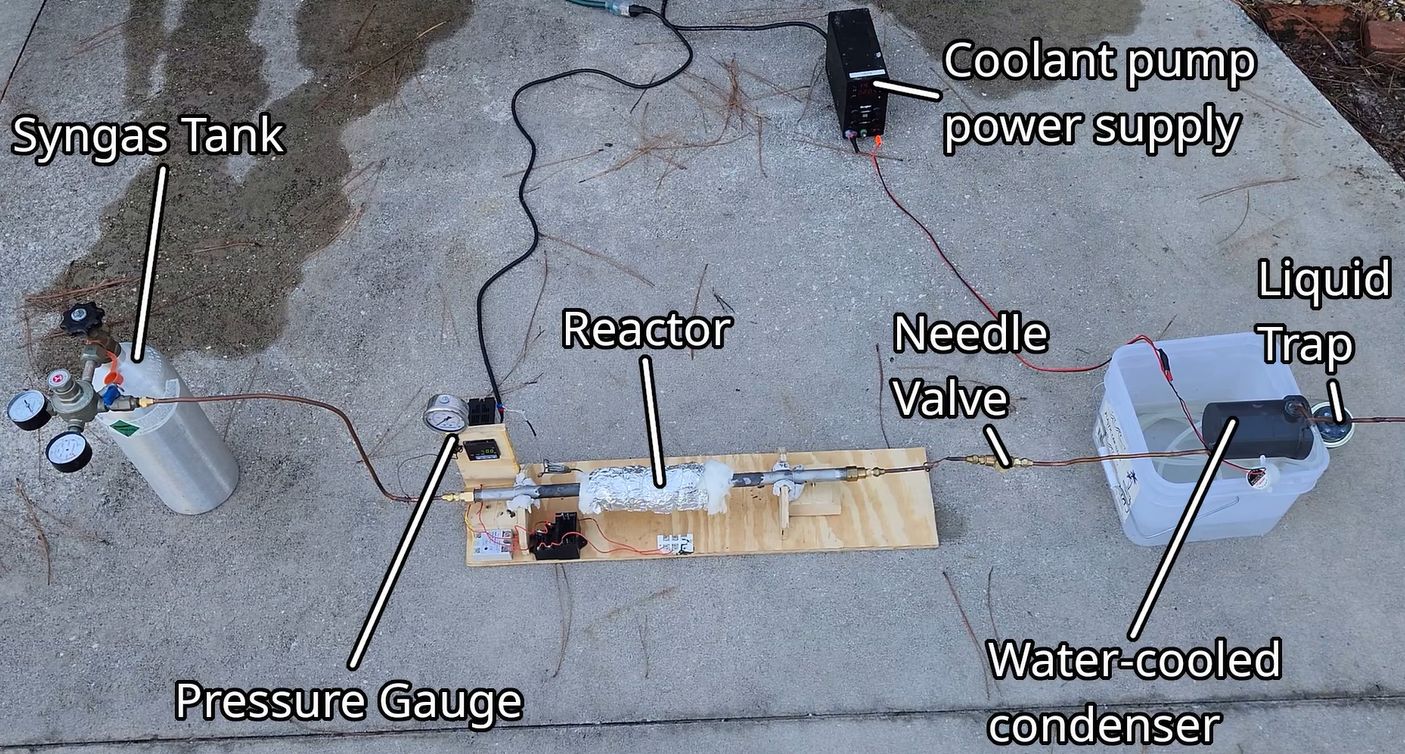
Although the Fischer-Tropsch synthesis (F-T synthesis) process is well-known and on face value quite straightforward, using it for DIY production of a somewhat defined length hydrocarbons is fairly tricky. Turning Syngas into Hydrocarbons with the Right Alpha. This is the topic of a recent video by [Hyperspace Pirate], in which he goes over getting the right alpha value for his FT reactor to not just create the equivalent of crude oil.
This alpha value is determined by the temperature and pressure inside the reactor as the syngas – consisting of carbon monoxide and hydrogen – is encouraged by the catalyst material to turn into proper carbohydrates. At very low alpha values this process will finish very quickly, creating mostly methane (CH 4), while a higher number creates increasingly longer carbohydrate chains before they terminate with their final hydrogen molecules. Since this process is exothermic, this creates many exciting opportunities for a production batch to be ruined unless you can somewhat control the temperature and pressure inside the reactor vessel.
In the video a heater is used to kickstart the reaction, before it is turned off. As a catalyst an iron-based material is created that is packed inside the steel tube which forms the reactor vessel. Through this the syngas is led, with the initial experiments producing a few mL of what appears to be pentane and hexane, with the rest apparently being gaseous methane, ethane and similar.
Discover more from ChuckysCarnage
Subscribe to get the latest posts sent to your email.

